
SAP Credit Management in SAP S/4HANA: How to Reduce Risk in Business Processes!


When customers do not pay, credit management is necessary. In SAP, SAP Credit Management keeps track and helps companies efficiently monitor and manage credit status and lending.
Payment defaults and financial bottlenecks – no one needs such risks. When customers do not pay, it can have devastating consequences. Without structured credit management, companies take on unpredictable risks. However, this does not have to be the case. The solution is credit management – and the tool for it, admittedly not very creatively named, is SAP Credit Management. This tool from the Walldorf software house has a clear mandate: to identify, control, and minimise credit risks early.
SAP Credit Management transfers and integrates the company's credit policy into the IT system. It uses information from various sources (e.g., past transactions or customer credit reports) to establish rules for credit management. Every credit-related sales process is checked and assessed according to these rules to ensure a secure business outcome.
Overview of SAP Credit Management
In SAP S/4HANA, SAP Credit Management is a component of SAP Financial Supply Chain Management (FIN-FSCM). In contrast to the previous FI-AR-CR module in ECC, FSCM Credit Management offers numerous improvements, including:
- Central management of credit master data via the business partner (BP)
- Automated credit limit checking processes
- Enhanced capabilities and integration of external credit files
The following table provides an overview of the key functions of FSCM Credit Management:
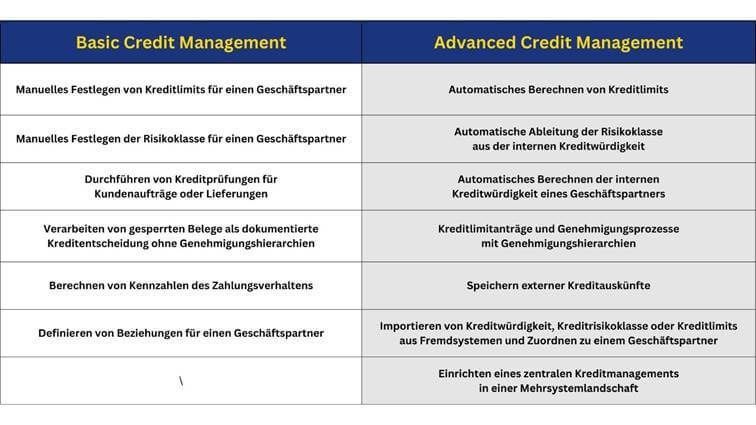
The basic functions we will discuss in detail are included in the SAP S/4HANA standard. Advanced functions such as automatic calculation of internal creditworthiness, automated determination of risk class, credit limit requests, or approval processes are part of Advanced Credit Management and require an additional licence.
Basic functions in detail
SAP Credit Management is closely linked to SAP Business Partner, as the credit master data is managed through the business partner role"UKM000 SAP Credit Management"Additional functions are included in this role, allowing for the maintenance, control, and monitoring of master data.
Three central components of credit master data are:
- Credit profile data (information on creditworthiness, risk class, checking rules)
- Credit segment data (individual credit limits per segment)
- Business partner relationships (assignment of approvers and credit managers)
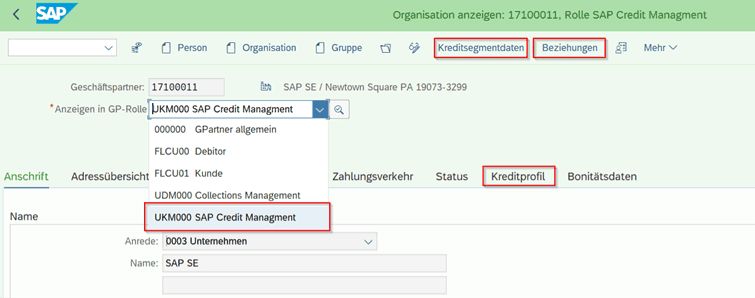
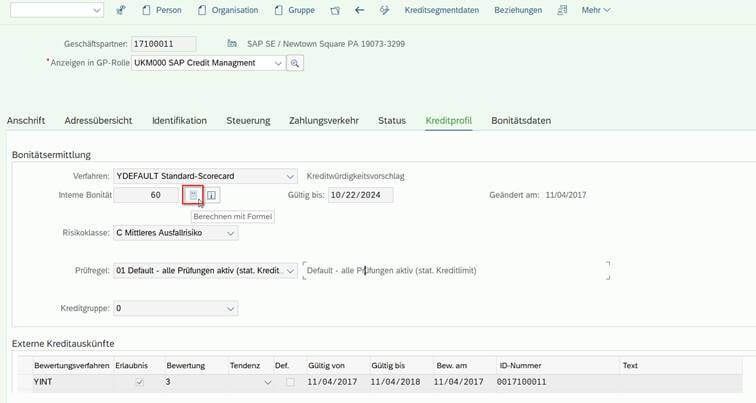
The credit profile contains all information for credit assessment and decision-making. A business partner can be assigned to a risk class, a checking rule, and a credit group.
Excursus on Advanced Credit Management
In Advanced Credit Management, internal credit assessment is automated based on a defined formula. The system monitors the validity of this assessment according to a set credit procedure. Furthermore, it is possible to store external credit reports, notes on credit data, or additional information in credit management to capture comprehensive credit information of a business partner. Additionally, a processor assignment can also be made through a set of rules (Advanced Credit Management).
The risk class assesses the business risk of a customer and determines which checks are conducted in the sales process. Checking rules consist of several checking steps. They specify the parameters and thresholds for customer order checks and how the results are recorded. Companies can group customers by industry, country, or other criteria to target credit management effectively.
Credit segments are flexibly definable organisational units of SAP Credit Management, which can be structured by product types, sales areas, or posting areas. In the "Credit Segments" tab, credit granting and control (e.g., credit limit and payment behaviour) are managed across different business areas. Here, the credit check can be simulated – and the log shows whether the credit check is successful and under which rule the check is conducted.
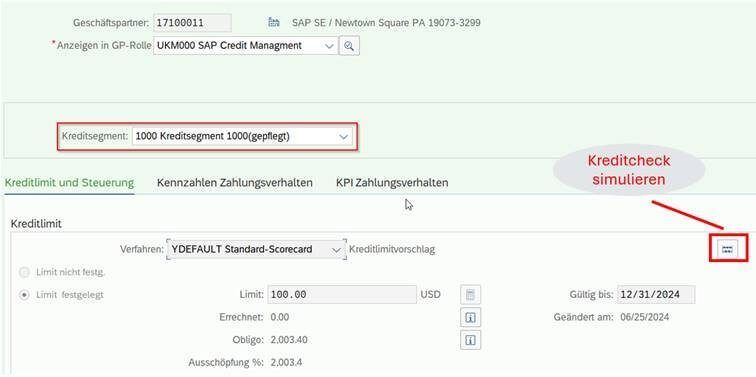
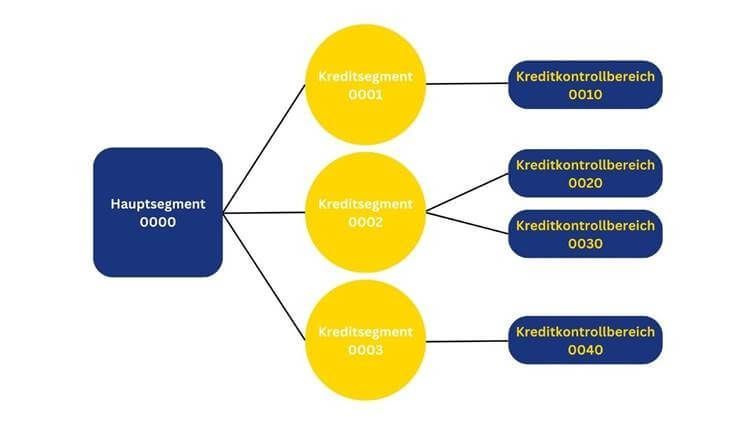
The credit segment can be assigned to one or more credit control areas. As an organisational unit, a credit control area corresponds – depending on configuration – to one or more posting areas or sales areas. It sets or controls the credit limit for customers.
To establish an overall credit limit at the corporate level, the use of the main credit segment is necessary. All other credit segments can be assigned to this main segment and receive individual credit limits.
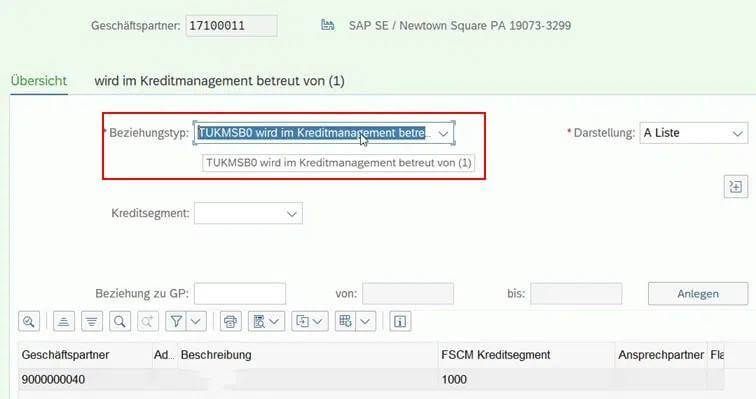
In the "Relationships" tab, employees are assigned as approvers for credit management through the relationship type "managed in credit management by". Thus, the approvers can process credit limit requests or blocked sales documents in the future sales process.
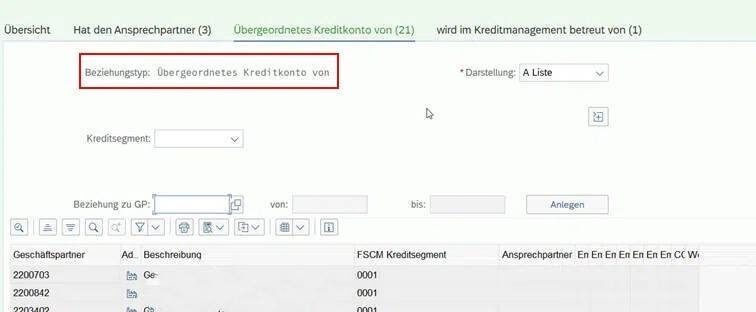
Additionally, the relationship of the credit hierarchy can be maintained through the relationship type "parent account of". The credit check is conducted at the parent customer, which is why only the credit limit of this customer needs to be maintained.
Credit checking and approval processes
In Customising, credit limit checks can be defined for various sales and delivery document types. When creating a customer order, an automatic credit check is performed. If this is unsuccessful, it can have various causes, such as:
- The order value exceeds the credit limit.
- Overdue open items.
- The validity of the credit limit has expired.
If a credit check fails, SAP Credit Management issues warnings or errors, and delivery is blocked. To release this, the following transactions are available:
- VKM1 (Process blocked sales documents)
- VKM4 (Process sales documents)
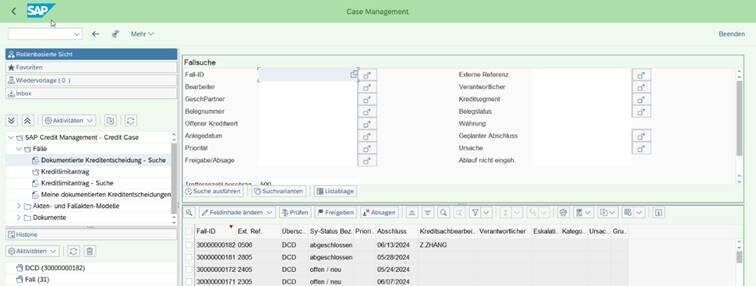
- UKM_CASE (Case management for blocked documents & credit limit requests)
Another way to request a credit limit is in the master data under the tab "Credit Segment Data". The approval process is also handled in case management.
Fiori Apps for SAP Credit Management
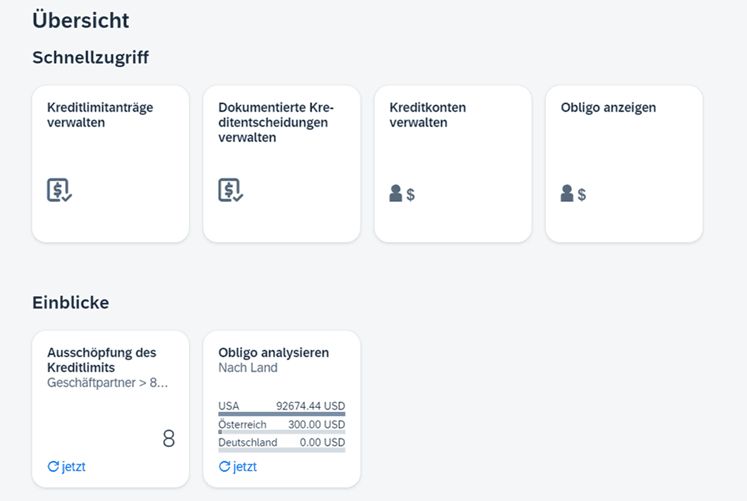
Currently, over 70 Fiori Apps are available for SAP Credit Management (SAP Fiori Apps Reference Library). Particularly relevant for operational use are:
- Manage credit accounts (View credit master data & blocks)
- Manage documented credit decisions (Processing blocked documents)
- Utilisation of the credit limit (Analysis of remaining limit)
- Analyse obligations (Assessment of credit usage)
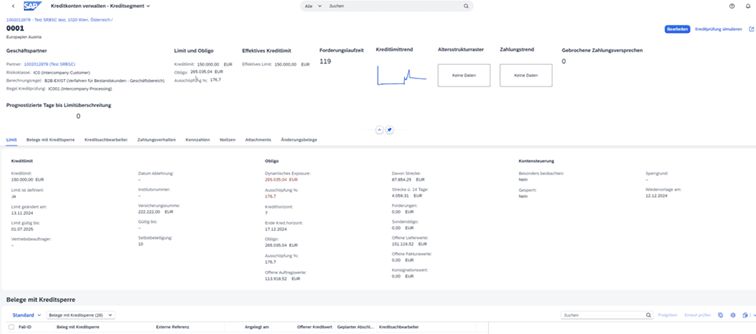
In the app Manage credit accounts, all credit master data, i.e., credit profiles & credit segments of a business partner, are to be maintained. Documents with credit blocks are also displayed here – and with a click, one can be redirected to a document and edit it.
Under the credit segment, any segment can be managed. More information about credit limit, obligations, and utilisation is displayed.
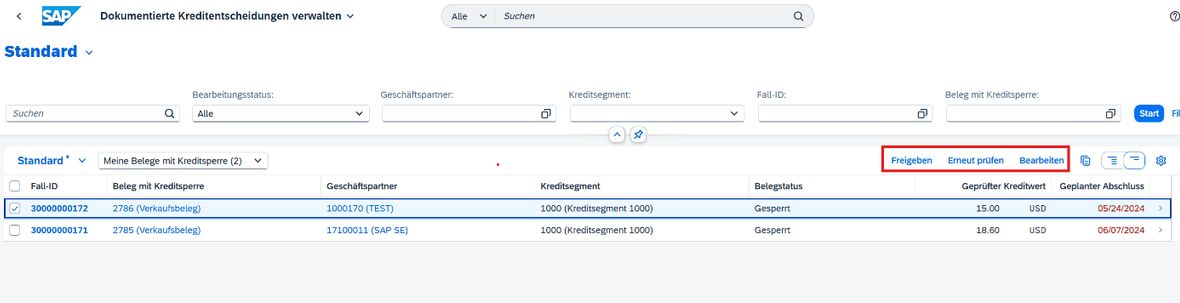
In the app Manage documented credit decisions, it is possible to carry out approvals for blocked sales documents.
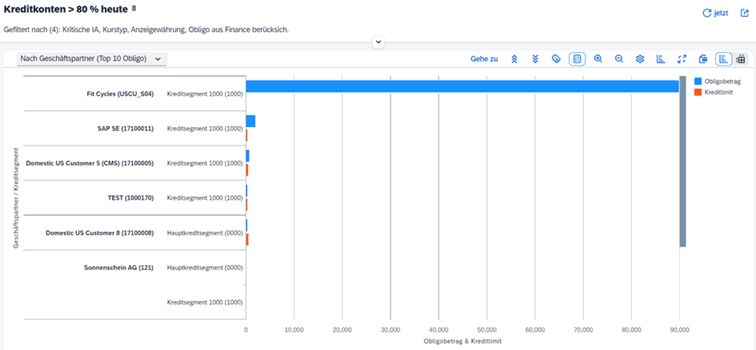
The analytical Fiori Apps are particularly helpful, especially Utilisation of the credit limit and Analyse obligations. They allow, for example, identifying the top 10 customers with the highest credit limit utilisation or defining individual thresholds. The representation is also clear: KPI-based, the credit limit utilisation of a business partner is displayed either as a percentage or absolute amount.
Conclusion
In summary, it can be said that SAP has launched a smart, simple solution for credit management with SAP CM. Particularly striking are the extensive functions for assessing and monitoring credit risks, such as setting credit limits and conducting real-time credit checks. For companies that require strict control and management of customer credits, SAP Credit Management is particularly suitable. In practice, it provides an excellent solution, especially compared to the predecessor solution, with a deep integration of SAP Credit Management with other modules such as Financial Accounting (FI) and Sales (SD), enabling consistent and efficient processing of credit information across various business processes.
Regardless of whether it is a new SAP S/4HANA implementation or a conversion project – it is advisable to integrate SAP Credit Management early into the corporate strategy. Companies should decide early which posting areas and sales areas will be used for credit management and define the corresponding credit control areas and credit segments.
If you are wondering how your company can better manage credit risks, do not hesitate to contact us. Let us analyse together how SAP Credit Management can optimise your processes as well!
