
SAP Cloud ALM & SMEs: Lean Tool, Sufficient Functionality?


SAP Cloud ALM is a lean tool. Cloud-native, flexible, agile. It can do quite a bit, but not everything. Is that enough, especially compared to the SAP Solution Manager? Questions we address in Part 4 of our series.
As described in Part 3, SAP Cloud ALM supports a requirement-driven implementation approach. Requirements deviating from best practices are developed in fit-to-standard workshops and stored as standalone objects (Requirement) in SAP Cloud ALM. This creates a seamless connection between requirement, process, implementation, and testing.
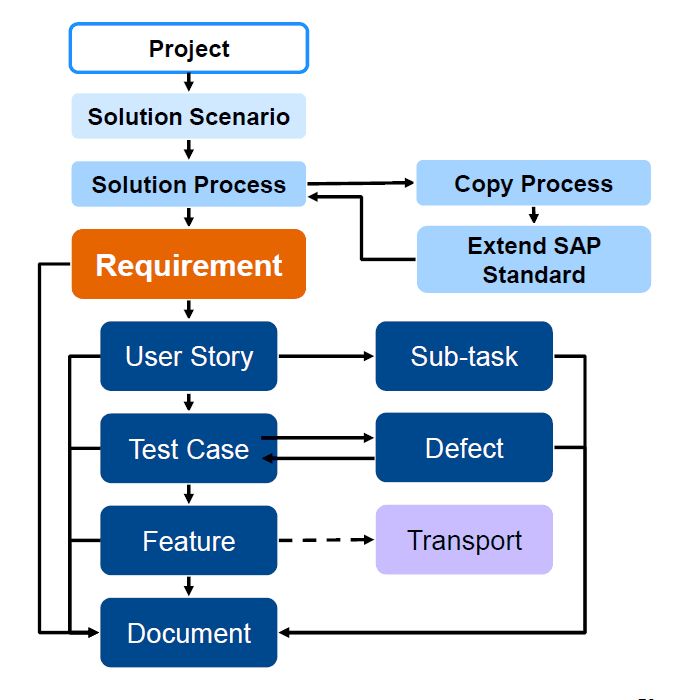
Elements in SAP Cloud ALM for requirements management. Source: SAP
After approval by the Business Process Owner, the requirements are transformed into user stories and tasks. This creates the initial backlog, which is structured into increments and implemented. The good thing about SAP Cloud ALM: The entire process is documented, versioned, and trackable by status.
From this initial requirements backlog, detailed planning gradually emerges in the project object of SAP Cloud ALM: Requirements are linked with project tasks and features, planned in sprints, and implemented in the Realize phase. This allows for transparent tracking of which requirements are in analysis, implementation, or testing at any time. And this works reliably and comprehensively in reality, not just on paper.
Ensuring quality through test management
At the same time, test management is set up. This covers the entire test lifecycle: from planning, through execution to evaluation. Here, SAP Cloud ALM is helpful by linking test-relevant processes and requirements with test cases and organising them in test plans and test cycles.
SAP provides a set of test cases for all standard processes, which can be generated and executed directly from SAP Best Practices. Those who want or find the standard set insufficient can also create their own manual test cases or import existing Excel or Xray test lists from previous projects or other test management tools without media disruption.
During the test phases, the project team centrally manages the execution of these manual and automated tests via SAP Cloud ALM through the test plans, monitors progress, documents test logs and defects, and prioritises errors to eliminate them before go-live. All results are also securely stored in the system; dashboards provide a clear overview of test status, deviations, and error-prone processes. This not only creates continuous transparency but also enhances quality throughout the testing process.
Managing deployment and go-live
When a release or project enters the deployment phase, SAP Cloud ALM orchestrates the deployment through change and deployment management, typically in conjunction with Cloud Transport Management. The feature object is the central element for change documentation and deployment control. It allows for easy assignment of transports, straightforward traceability through the feature history, approval workflows with the step 'Ready for Production', and deployment only after approval – all practical functionalities that ensure more transparency and control in project management.
The technical and functional cutover is processed according to defined task lists, and go-live is accompanied by status, monitoring, and post-go-live tasks. This keeps requirements, tests, and deployments continuously connected.
A bonus is certainly that SAP Cloud ALM can manage hybrid scenarios, where SAP Cloud Transport Management (CTMS) is used for cloud components and the SAP Solution Manager for on-premise parts.
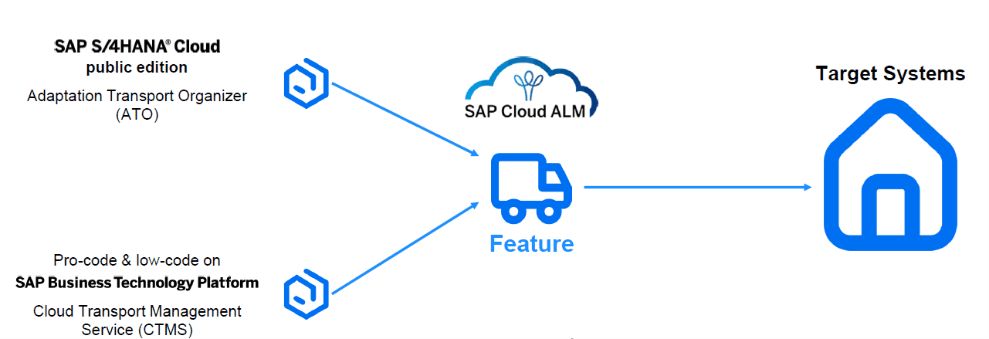
Transport management across different solutions. Source: SAP
SAP Cloud ALM - Insights and Background
In our blog series on 'SAP Cloud ALM & SMEs', we look at the SAP tool from different perspectives and explore why it is worthwhile for many SMEs to rely on it. Here is an overview of the past contributions:
Part 1: Why does the local SME need SAP Cloud ALM?
