
All good with empties? Packaging logistics in SAP

Whether products or goods – it is unquestionable that these items are managed in stock and movements are recorded in SAP. Load carriers, however, often lead a shadowy existence. Unjustly so. The SAP standard offers functions to manage them.
Whether production materials, products or goods – it is usually hardly a question that these items are managed in stock and all movements are recorded in SAP. Load carriers, however, often lead a shadowy existence. Unjustly so. The SAP standard offers functions to manage them. Which ones, and what needs to be done to use them efficiently, you can read here.
One thing upfront: empties, load carriers or packaging – call it what you will. I do too. Sure, there are subtle differences here and there. Nevertheless, I use these terms synonymously in this article. After all, the nomenclature in various SAP documents follows this approach.
Otherwise, the management of empties does not fundamentally differ from that of other materials. A number of requirements overlap, a few apply specifically to these:
- Inventory management and traceability: Movements of empties should be recorded both in quantity and value, whereby a distinction must be made between bound and unbound empties.
- Disposition: Just like direct materials, load carriers are needed for production and can cause downtimes in out-of-stock scenarios. Therefore, they must also be planned to ensure they are available at the right place at the right time.
- Management of loan accounts: Since load carriers are often exchanged throughout the entire supply chain, a tool is needed to track who owns them and where they are located.
- Automatic billing and deposits
SAP has several functions that address these requirements.
- Inventory management
- Handling Unit Management
- Management of empties
- Management of loan accounts
Some of these overlap or cover similar requirements, but in different ways. Depending on the need and environment, it is essential to select the appropriate tools from these functions and set them up to interact seamlessly.
Inventory management
Like any other material, packaging materials can be recorded in stock and value, provided the designated material type allows it. Furthermore, Extended Warehouse Management (EWM) or Warehouse Management (WM) or Stock Room Management can be connected to inventory management, as detailed in thisblog entry. In the simplest case, empty load carriers are recorded upon receipt in goods receipt and upon consumption to a cost centre or production order. This way, one always has an overview of how many empty packaging materials are available.
If you want to obtain the same information for bound load carriers, this can be enabled through the use of Handling Unit Management. At goods receipt, direct materials can be packed into handling units, specifying exactly which load carriers and packing aids are used. This way, one knows which handling units are in stock and which packing materials they contain, allowing for the determination of the number of bound load carriers.
At the same time, bound load carriers can also be recorded in stock, with a separate storage location recommended specifically for bound empties. This is particularly important as it not only facilitates the determination of their quantity but is also a prerequisite for some of the functions explained further below.
If one does not wish to pack each material manually and record the stocks individually, SAP offers the following tools:
Automatic packing
For each packed material, one can maintain single or multi-stage packing instructions in the master data, including load carriers and packing aids, as well as a search for these. If done correctly, materials can be automatically packed in incoming or outgoing deliveries.
Automatic generation of delivery items
In Customising, it can be set up that delivery items are automatically generated from the handling units packed in deliveries. For this, the generation of delivery items for packing materials must be enabled in the Customising of the delivery type, and the packing material type must suggest a delivery item generation.
Depending on the item type group in the material master of the packing materials, different item types can be determined for these positions in the delivery. It can be set how they should behave, for example, whether they should be transferred to subsequent documents such as invoices or recorded in goods movements.
BAdIfor other movements
With the methods mentioned above, automatic goods movements of packing materials can only be generated for those bookings that are carried out via incoming or outgoing deliveries. However, if a material is simply repacked, no automatic movement of the used or released packing materials can be generated in the standard.
Here, the SAP BAdI BADI_HU_SAVE helps. The plug-in that runs with every change of a handling unit can be developed independently and allows, for example, to implement that an empty used for a packaging is transferred from a storage location for unbound load carriers to one for bound ones.
Disposition
When the stock of empty load carriers is booked in a timely manner, all prerequisites for correct disposition are met. The packaging materials can be planned by MRP like any other material, and all available disposition types (consumption and demand-driven) and lot size procedures can be used.
It is important that the stock of bound empties is not considered, as these cannot be used for packaging. This is ensured by either not including them in stock at all or managing them in separate storage locations or disposition areas that are not considered by demand planning.
Management of loan accounts
For the management of empty accounts from suppliers or customers, SAP offers two applications with similar functions:
- Management of empties:This originally comes from the Industry Solution for Consumer Products and was developed to manage the handling of reusable transport packaging, including deposit processing, throughout the supply chain.
- Management of loan accounts: This originally comes from the automotive industry. Here, OEMs (Original Equipment Manufacturers) provide their suppliers with empties as loan goods, in which they then package their materials and deliver directly or via third parties. The management of loan goods was developed to manage these lending and borrowing relationships between business partners.
Management of empties
The prerequisite for using the management of empties is the activation of the Enterprise Add-On EA-CP in the ECC Extensions (Business Functions). The following must be set up in Customising:
- Own material type with material identification for empties, with mandatory quantity tracking and optional value tracking
- Customising of own item types for the management of empties (including copy control up to invoicing)
- Customising Sales à Invoicing à Empty Tracking Definition of invoice types with empty tracking Define empty account holder: Here, it can be defined under which business partner an empty account is managed for the invoice. Define empty fields: Which fields of the invoice should be tracked in quantity and value? Assign item types to empty fields Optional: Define empty groups to group individual empty materials Optional: Maintain calculation matrix for empties to derive an empty field with arithmetic functions from other fields Set up number range for empty tracking
Those who have done this must still maintain the following master data for a functioning management of empties:
- Material master: Item type group for empties, weights, empty group
- Customer master: Partner role defined in Customising as account manager, disable empty deposit, disable empty tracking
- Bill of materials: through bill of materials type 5 (Sales BOM), empty materials can be assigned to a material.
Management of empties in Materials Management (MM)
When creating the order, full goods including bound empties (optionally automatically generated via the bill of materials) or unbound empties can be recorded. The prerequisite is the activation of BAdI /BEV1/NE_ITEM_PO for the determination and pre-filling of the account assignment, without which the management of empties in MM does not function. Load carriers returning to the supplier can be recorded as return items.
While bound empties are not relevant for goods receipt, unbound empties are recorded in stock. When booking the incoming invoice, the quantity and value of the empties can be corrected. Furthermore, with the booking, the movements and balances on the empty account are tracked, allowing incoming and returned empties to be offset against each other.
Management of empties in Sales (SD)
When creating the customer order, full goods including bound empties (optionally automatically generated via the bill of materials) or unbound empties can be recorded. Alternatively, empties can also be generated in the form of empty items in the delivery via packed handling units, as described above.
Incoming empties from customers can be represented through return deliveries. However, the copy control must ensure that the empties end up in the invoice, even if they are free of charge, as only here does the tracking on the empty accounts occur.
Evaluation of empty accounts
Movements of bound and unbound empties can be evaluated in transaction /BEV1/EMS, with balances per customer and supplier evaluated (and the latter also exported and printed) in transaction /BEV1/EMA.
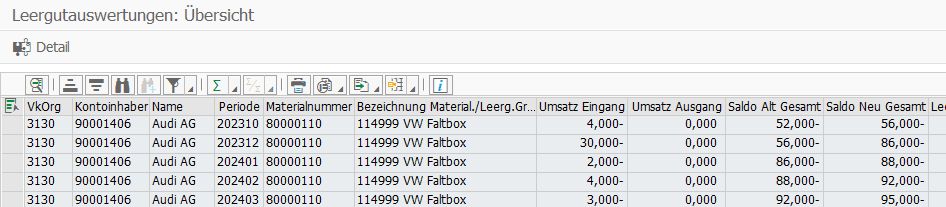
Extract of empty account
Management of loan accounts
The management of loan accounts is part of all SAP S/4HANA systems, with the following Customising needing to be set up under Materials Management à Management of loan accounts:
- Number ranges for various objects of loan account management (see Customising guide) must be set up.
- Account posting types for loan postings must be created.
- Account postings are always linked to material movements, which is why the account posting types must be assigned to MM movement types.
The following master data is required:
- Material master: Item type group for empties, weights
- Loan account: It establishes the connection between loan goods, plant, and customer/supplier (relation). In addition to a main relation, secondary relations can also be added. For example, bookings from different suppliers or customers can be summarised to one loan account.
Loan account postings
The prerequisite for an account posting is always a material movement of the empties. Only manual account postings are exempt from this, which then only post to one account and do not change stock.
When a loan good is booked with a relevant MM movement type, an account posting is also triggered. In addition to the plant and loan good, the goods recipient (supplier and customer) is determined, and a loan account that contains a relation with the three affected objects is posted. If, for example, no goods recipient can be determined or there is no account for the booked relation, the movement is erroneous but can be evaluated and corrected in a separate transaction for erroneous postings.
In addition to automatic postings, manual postings can also be triggered to represent special processes or to follow up on postings.
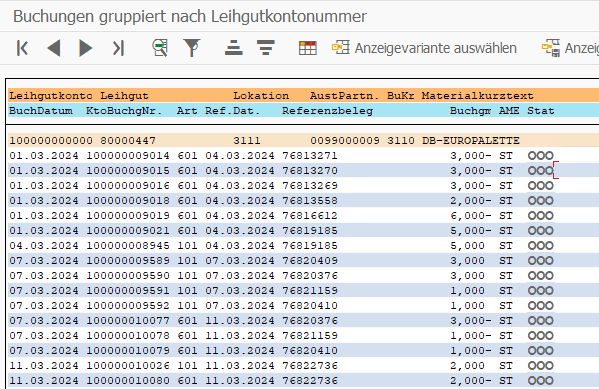
Evaluation of loan accounts
In the SAP menu under Logistics à Materials Management à Management of loan accounts, all movements and accounts can be evaluated according to various selection criteria. Furthermore, account statements can be created, printed, or sent via EDI. After receiving an EDI statement from a partner, the accounts can be reconciled.
Extract of loan account
Conclusion: All good with empties
As we have seen and read: empties can be recorded in stock like any other material – and with relatively manageable effort. It is positively noteworthy that a distinction can be made between bound and unbound empties, thus providing an important prerequisite for professional management. Bookings can always occur automatically when the movement is recorded via incoming or outgoing deliveries and packed in handling units.
Other movements or repacking processes are not supported in the SAP standard, but can be implemented customer-specifically via a BAdI in Handling Unit Management. With a correct stock of load carriers, these can then also be planned in the SAP standard.
The exchange of load carriers with business partners can be represented with the functions of management of empties and management of loan accounts. The management of empties is booked during invoicing and is designed to settle the exchange of empties including deposits with business partners. The management of loan accounts, on the other hand, serves to record which partners owe an empty or to whom one owes load carriers. The accounts are booked with goods movements, and their strengths lie in flexibility (different goods recipients can be summarised to one account) and in an automated reconciliation via EDI of all movements between business partners.
All in all, it can be concluded: everything is good with empties! Those who want a complete overview of their inventory management must and should integrate packaging logistics into SAP. And those who need support with 'packing' can count on our help at SRB.


