
How embedded is embedded EWM?

SAP EWM is the future of warehouse management. Although it now runs directly on S/4HANA, it mostly communicated via interfaces with other modules. The latest release and the introduction of 'Synchronous Goods Movements' streamlined this.
SAP Extended Warehouse Management, or EWM, in SAP S/4HANA is the future of warehouse management. Although EWM now runs directly on SAP S/4HANA, the system still mostly communicated via interfaces with other modules. SAP has now released 'Synchronous Goods Movements' with the latest release, significantly streamlining this interface.
At SRB, we are close to our customers – and as we know, many are currently or soon will be facing an important decision. Namely, how they want to handle warehouse management in SAP S/4HANA. Many are still using the classic Warehouse Management (WM). However, SAP positions EWM as a strategic product for the future. While WM can still be used, it will no longer be developed or supported. So what to do?
EWM is often viewed critically, especially in smaller warehouses. Although the solution is now embedded in SAP S/4HANA, it still communicates internally with other modules via interfaces – and the additional overhead this entails through the setup and maintenance of these interfaces is something many are unwilling to manage. Hence, the question arises as to how embedded EWM really is.
From WM to embedded EWM
To answer this question, a brief look at the development history of EWM is helpful. Originally, EWM was developed on the SCM system and was not embedded at all. Communication with the ERP (usually R/3) only occurred via interfaces, as these were two separate systems.
In 2016, EWM was then integrated into SAP S/4HANA, operating there as embedded EWM. Initially, the coding was more or less directly adopted, meaning EWM ran on the same system but still communicated with ERP via qRFC (queued Remote Function Call). For example, when a goods receipt was posted in transaction MIGO, a delivery was created in ERP and sent to EWM. There, it was posted, and this posting was sent back from EWM to ERP.
Over the years, embedded EWM has been further developed, and since 2018, SAP has gradually worked to eliminate this interface, especially for inventory postings.
Synchronous Goods Movements – a milestone for warehouse management
With the synchronous goods movements as of SAP S/4HANA 2022, SAP has achieved a significant milestone in simplifying warehouse management. To use this, they must first be activated in the customising. This can happen generally, but each individual movement type can also be activated or deactivated separately. Only goods receipts and consumption for production orders must be set up elsewhere, namely in the production control profile.
If one now posts a goods movement in an EWM-managed storage location and a movement type that has activated synchronous goods movements in MIGO, a new tab 'Warehouse Management' appears:
Source: SAP
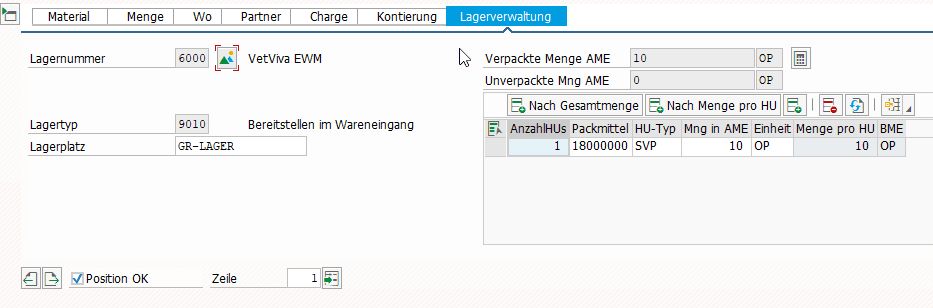
In this, a storage location must be specified. Furthermore, handling units (HUs) can also be created directly and packed into them. With the posting in MIGO, the booking is then made directly in EWM at the specified location (or taken from there).
Challenges in implementation
In April 2023, I had the opportunity to accompany my first go-live with synchronous goods movements at a customer. During the project phase, there were several challenges to overcome, as most of the innovations were only a few months old. But this is the well-known 'fate' of 'early adopters', which we gladly faced.
Especially the QM integration posed several challenges, for example in the creation of inspection lots, where inspection lots were not visible in MD04 and much more. Here, we quickly received OSS notes for correction and developed the solution for it. The logical consequence: the go-live itself was very successful, and the postings worked flawlessly. To this day, I am waiting to show the key user how to process the RFC queue, but so far no errors have appeared there. For the customer, this means a significant saving of time and effort, as no erroneous transmissions need to be processed anymore, and the stocks on both sides are always synchronised.
Nevertheless, there are still postings that are carried out via qRFC. For example, deliveries are still replicated to EWM, and the goods issue posting does not occur synchronously. This is a potential source of error and means that there is still no information about the status of a delivery in the other modules. This is sent to EWM, but feedback only occurs again at goods issue. Unfortunately, no improvements are visible in the current roadmap. Therefore, it will likely take some time before anything changes here.
Is embedded EWM worth it?
Based on the initial experiences with embedded EWM and synchronous goods movements, it must be noted that this is a very successful development that brings significant advantages and savings in time and effort for customers. Furthermore, it allows for processes to be streamlined and simplified in the future. Especially for customers considering switching from WM to EWM as part of the transition to SAP S/4HANA, this often-cited obstacle is removed.
Do you need support with your warehouse management or have questions about embedded EWM? Then feel free to contact me without obligation. I am happy to assist you!


