
SAP Transport Management for SAP S/4HANA: The Next Logical Step


Those who managed their transport logistics in SAP relied on LE-TRA. With the introduction of SAP S/4HANA, it became clear that it would no longer play a strategic role in the long term. New focus: SAP Transportation Management. But what can the new solution do?
Those who wanted to manage their transport logistics in SAP efficiently and reliably previously relied on the SAP module LE-TRA. However, with the introduction of SAP S/4HANA, it became clear that LE-TRA would no longer play a strategic role in the long term. New focus: SAP Transportation Management (SAP TM). But what can the new solution do?
With SAP S/4HANA, SAP has placed a new solution at the centre of logistics with SAP TM. This decision marks a clear shift in direction. While LE-TRA will still be supported in classic SAP ECC until the end of 2027, support via the so-called compatibility layer in SAP S/4HANA will end no later than 31.12.2030. For companies that wish to continue seamlessly mapping their transport processes in SAP, the question arises: What to do?
It is clear: SAP TM is the future-proof alternative. It is not only available as a successor to LE-TRA but also opens the door for companies that have not previously used an SAP-based transport solution to enter a modern, integrated logistics platform. The solution, which allows for both simple shipping processes and highly complex transport planning and optimisation, is suitable for various company sizes – from medium-sized shippers to globally operating logistics networks.
SAP TM is available both as a standalone solution and as an integrated component of SAP S/4HANA. From version S/4HANA 1709 onwards, part of the TM functionalities is included in the standard and can be used under certain conditions without additional licensing costs.
Consider the transition decision individually and holistically
Even though the future is clearly outlined, not every organisation necessarily has to switch to the complete TM solution immediately – the path can be tailored individually. After all, migrating from SAP TM to the SAP S/4HANA world is more than just a version change. It is a strategic step towards integrated, high-performing, and future-ready logistics processes.
SAP S/4HANA not only offers a modernised data structure but also enables the seamless embedding of TM into central ERP processes without interfaces and detours. This creates a consistent platform for all who wish to set up their transport logistics holistically, scalably, and digitally – even for companies that have not previously used an SAP solution in this area.
SAP TM – a closer look
But what exactly is SAP TM? What models have existed and do exist? What role does a transition to the new SAP S/4HANA world play? We take a closer look and explain the fundamentals of SAP TM – from the past to the current SAP strategy.
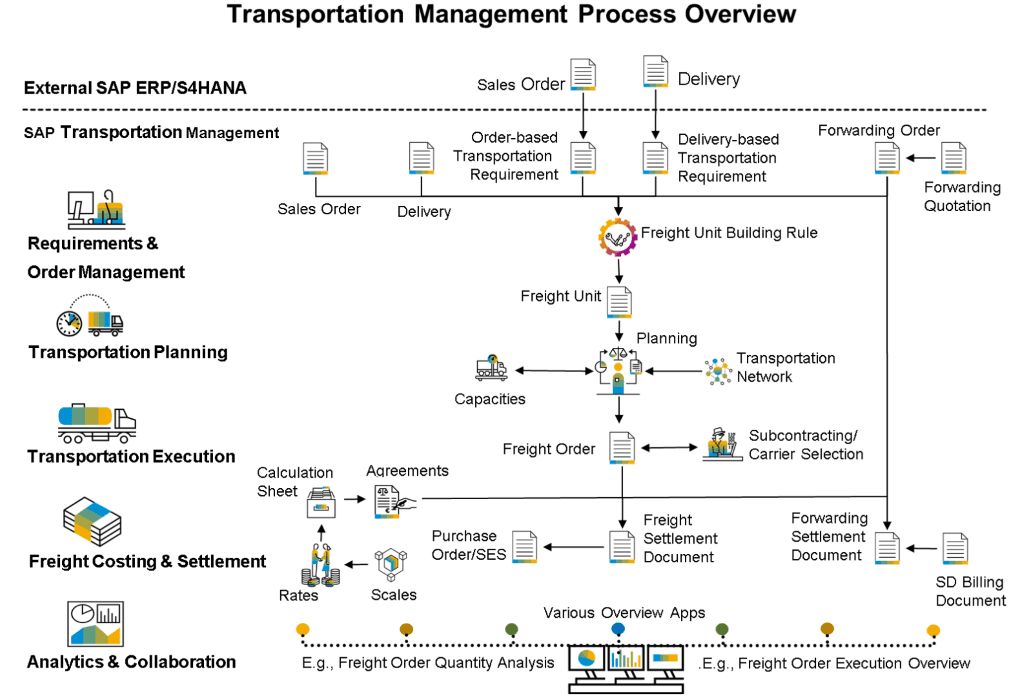
What is SAP TM and how does a typical transport process work within it?
SAP TM is SAP's central solution for mapping, controlling, and optimising transport processes along the entire supply chain – for both shippers and carriers. SAP TM covers the entire lifecycle of a transport: from capturing requirements to planning and execution to billing. It enables companies to design their transport logistics efficiently, transparently, and cost-optimally – regardless of whether they manage national or international transports.
A typical transport process in SAP TM is divided into the following steps:
- Transport Request (Freight Demand Management): The process starts with capturing transport requests, which are usually generated from customer orders (Sales Orders) or deliveries (Outbound Deliveries). These requests form the basis for further transport planning. They can be processed in an integrated scenario (e.g., within SAP S/4HANA) as well as in a decentralised TM system.
- Freight Unit Building: Based on the transport requests, the system creates so-called Freight Units – the smallest logistical unit for transport planning. Criteria such as weight, volume, delivery time, or transport mode are taken into account.
- Transportation Planning: The planning can be manual by dispatchers or automated using integrated optimisation algorithms. The goal is to bundle freight units, design routes efficiently, and maximise the utilisation of transport modes. Factors such as time windows, capacities, modes of transport (road, rail, air, sea), and costs are included in the planning.
- Carrier Selection & Tendering: Suitable carriers can be directly assigned or selected through tenders. SAP TM supports both automated tendering and manual awarding processes. Contract terms, price lists, and historical performance data can be considered in the selection.
- Execution: During the execution of the transport, shipments are monitored. SAP TM enables Tracking & Tracing through status messages, GPS data, or a connection to telematics systems. This allows the current location and status to be tracked at any time.
- Freight Settlement: The calculation of transport costs is based on stored freight agreements, tariffs, and surcharges. The generated billing documents can be directly transferred to SAP S/4HANA and used for further cost accounting or invoicing.
- Monitoring & Analytics: SAP TM provides KPI-based dashboards and analyses to monitor costs, lead times, utilisation, and service levels. This creates transparency and supports informed decisions for continuous process optimisation.
This process shows: SAP TM is much more than just a planning tool. It is an integrated end-to-end solution for managing modern transport processes and offers the appropriate depth of functionality for both companies needing simple shipping processes and those with complex, multimodal networks.
Source: SAP Learning Portal
SAP & Logistics: The Evolution of a Solution
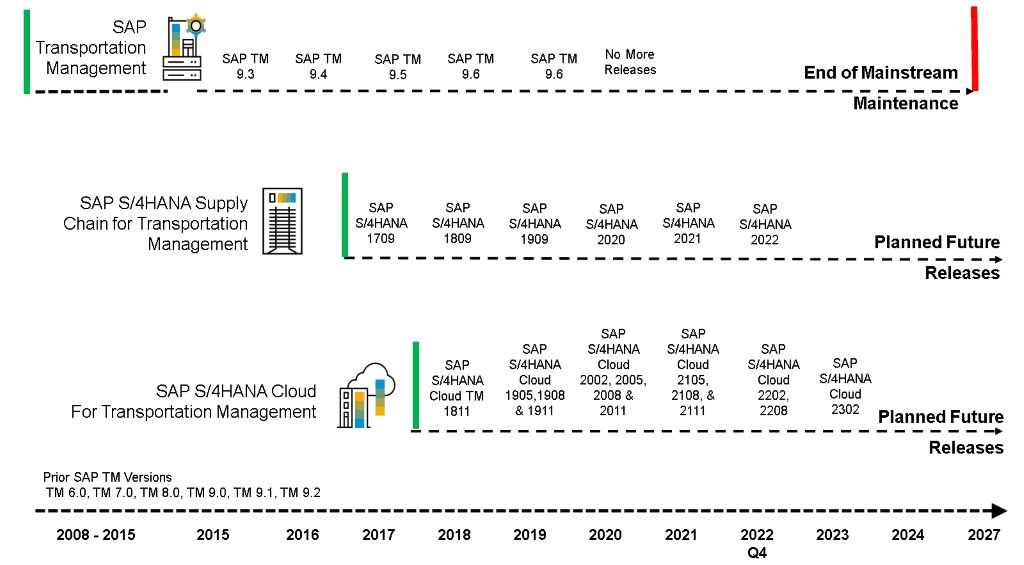
SAP offers three different solutions in the field of transport logistics, which differ in structure, functionality, and strategic orientation: LE-TRA, SAP TM (Standalone) and SAP TM for S/4HANA, also known as 'Embedded TM'. These solutions represent a clear development line from classic shipping processing to a modern, integrated platform for transport management in SAP S/4HANA.
LE-TRA: The Classic Transport Module
LE-TRA, short for Logistics Execution – Transportation, is a proven solution within the classic SAP ECC system. It is used for processing basic transport processes such as shipping, transport documents, and freight cost settlement. LE-TRA is closely linked to the SD (Sales and Distribution) and MM (Materials Management) modules and is based on the traditional SAP GUI. SAP no longer considers LE-TRA strategically relevant today. Maintenance will end in SAP ECC on 31.12.2027 and in SAP S/4HANA (via the compatibility layer) no later than 31.12.2030.
SAP TM (Standalone): The First Generation of Modern Transport Solutions
With SAP TM a standalone, more powerful solution was developed, which became part of the SAP Business Suite based on NetWeaver from version 8.0. SAP TM (Standalone) is aimed at companies with more complex logistics requirements and enables advanced functions such as transport planning, optimisation, carrier selection, tracking & tracing, and detailed freight cost settlement.
The current version is SAP TM 9.6. This solution operates as a separate system alongside SAP ERP and is not fully integrated. Integration occurs via the Core Interface (CIF), which transfers master and organisational data from SAP ERP or SAP S/4HANA to SAP TM. For the integration of movement data, transport demands based on delivery/orders (DTR/OTR) are created via web services. SAP TM 9.6 is the last standalone version and is not available as an embedded variant in SAP S/4HANA. It is based on the classic SAP Business Suite and NetWeaver architecture.
Maintenance for SAP TM (Standalone) is planned until 2027. All future extensions and upgrades will be based on the SAP S/4HANA offerings. Customers starting new implementations should consider either SAP S/4HANA Supply Chain for Transport Management (on-premise) or SAP S/4HANA Cloud for Transport Management (public and private cloud).
SAP TM for S/4HANA: The Integrated Future
With the release of SAP S/4HANA 1709, SAP TM was first directly integrated into the S/4HANA core – as part of the 'SAP S/4HANA Supply Chain for Transportation Management'. This embedded version combines the advantages of the standalone solution with deep integration into the S/4HANA processes.
While S/4HANA 1709 initially only offered basic functions for shippers, S/4HANA 1809 already achieved functional parity with TM 9.6. From S/4HANA 1909 and in all subsequent releases, the functionality has been further improved. The user interface is based on modern Fiori apps, and usage occurs directly in the ERP system – without interfaces or duplicate master data maintenance.
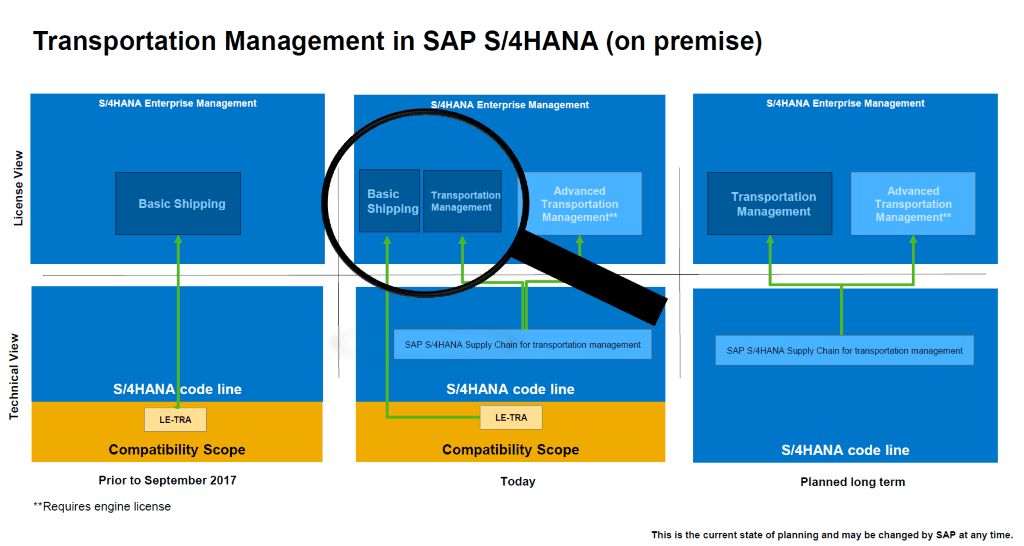
SAP distinguishes between two usage scenarios here:
1. Transportation Management (formerly Basic Shipping)
- Offers basic functions for shipping – comparable to LE-TRA
- Can be used without a licence (part of the S/4HANA ERP licence)
- Uses the same data base and infrastructure as the Advanced variant
- Ideal for simple shipping processes
2. Advanced Transportation Management
- Includes advanced functions: transport planning, optimisation, carrier selection, freight cost management, etc.
- Licence required – depending on the estimated annual freight volume
- Suitable for companies with complex, global transport requirements
SAP TM in the Cloud
In addition to the on-premise variant, SAP also offers a cloud version of TM: SAP S/4HANA Cloud for Transportation Management. This solution is aimed at companies that prefer a scalable, modern infrastructure with automated updates, lower operating costs, and high flexibility – both in the private and public cloud.
Where the journey is headed – and what SAP recommends
With the technological shift towards SAP S/4HANA, SAP's strategic orientation in the field of transport logistics is also changing. While the classic LE-TRA module can still be used as an integrated module within SAP ECC via the compatibility layer until the end of 2030, thus allowing for a gradual migration to SAP TM, it is no longer officially considered part of the future SAP target architecture. New developments, functions, or innovations will no longer take place there, as SAP is fully focused on the further development of SAP TM.
SAP releases new versions annually for the on-premise version of SAP S/4HANA. The cloud variant of SAP TM is even updated quarterly, bringing innovations to the productive systems even faster. Companies that desire continuous improvements and lower upgrade effort should therefore evaluate the cloud option.
It is therefore not surprising that SAP recommends the following:
- For new implementations or S/4HANA migrations, SAP TM (embedded) is the recommended solution.
- LE-TRA is tolerated as a transitional solution but is not future-proof.
The SAP Road Map Explorer provides an overview of planned developments, functions, and strategic goals for SAP TM.
Conclusion
The decision to transition from LE-TRA to SAP S/4HANA Transportation Management is not only technologically necessary but also strategically sensible. SAP has clearly signalled that LE-TRA has no future – neither functionally nor legally beyond the year 2030. With the introduction of embedded SAP TM in S/4HANA, companies now have access to a modern, scalable, and deeply integrated solution that can accommodate both simple shipping processes and complex transport requirements. There is no real reason to delay the migration until the end of LE-TRA's 'expiry date' – especially since there is the possibility of a gradual and thus priority-focused transition to SAP TM.
But how does the transition succeed concretely?
In our next blog post, we will show you step by step how a migration from LE-TRA to SAP TM for S/4HANA takes place – from the preliminary analysis to the technical preparation to the gradual adjustment of your processes. Stay tuned!


