
Vibe Coding meets SAP: How far can you go without classical development?

AI is also changing software development. Under the term 'Vibe Coding', a new approach is emerging: developers describe requirements in natural language, and an AI system generates most of the code. How far can you go with this?
Artificial intelligence is not only changing business processes but increasingly also software development. A new approach is currently emerging under the term 'Vibe Coding': developers describe their requirements in natural language, and an AI system generates most of the code. But how far can you go with this, especially in SAP environments? A self-experiment.
Modern dashboards and user interfaces are now among the most important requirements for users. This is also true in SAP. At the same time, traditional SAP interfaces often reach their limits when it comes to flexibility, design, or quick adjustments.
When it comes to speed and efficiency in IT today, the term AI is often not far behind. Artificial intelligence is changing the world and thus also software development. Vibe Coding is the buzzword that every developer fears. However, what is already successful for smaller tasks seems illusory in complex environments like SAP. Or is it?
To answer this question, we conducted a small experiment: the goal was to develop a modern dashboard that retrieves data via an SAP API and represents the functions of an existing Maintenance Cockpit. How quickly can such a dashboard be developed with AI support – and what is the quality?
Prompting instead of coding
Anyone who has dealt with AI in software development knows: the actual development process differs significantly from classical programming. Instead of writing code line by line, the focus here is on formulating requirements. The AI needs detailed descriptions of the SAP interface used, the desired functions, and the structure of the dashboard. It then independently generates large parts of the necessary code.
In our project, the technical basis consisted of the following:
- an SAP system with API access
- a development environment with an integrated Large Language Model (LLM)
- the required API metadata
- a clear description of the desired functions
Even in the initial attempts, it quickly became apparent: the more precise and detailed the requirements are formulated, the better the result. Smaller adjustments can often be implemented with just a few prompts. However, for more complex functions, a precise description of the desired logic and user guidance is crucial.
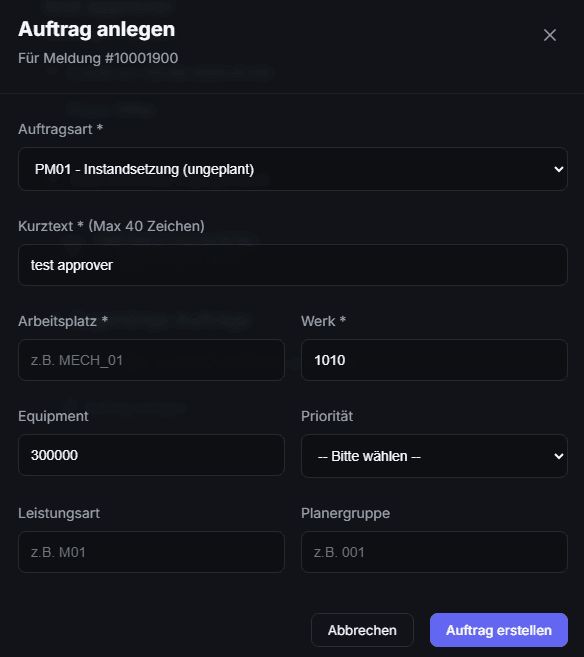
"Okay, can you add the function to create an 'order' for a report? It should be a button that opens a form where you can enter the mandatory details and the most important information."
The results: really strong and full of potential
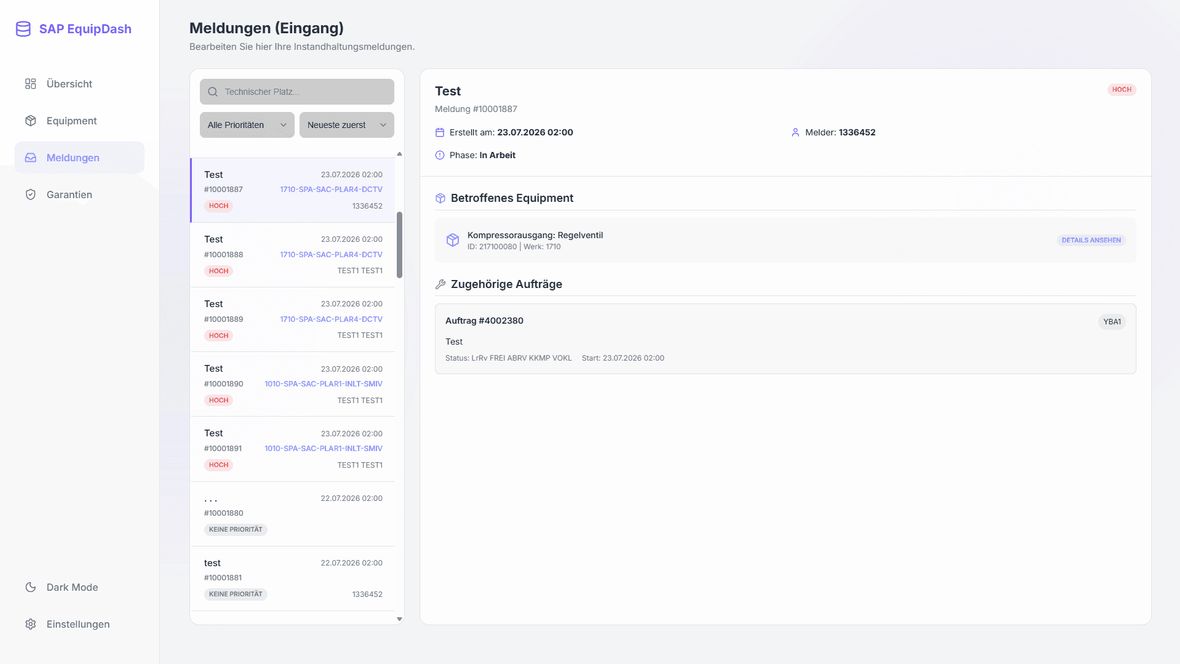
Our experiment impressively demonstrates how much AI can increase development speed. Within a short time, a functional prototype was created that could retrieve data from SAP and display it in a modern interface. Tasks that would traditionally require several development steps could, in my personal estimation, be implemented significantly faster.
Thinking further, this type of software development seems to open interesting possibilities with many advantages, especially for prototypes, proofs of concept, or initial departmental applications. One can expect...
- shorter development cycles
- faster validation of ideas
- lower entry barriers for initial solutions
- higher innovation speed.
Why Vibe Coding fits particularly well with the future SAP strategy
As if the aforementioned advantages were not already reason enough to give Vibe Coding a chance, the results also highlight a fundamental change in modern SAP landscapes. Companies are increasingly pursuing a so-called Clean-Core strategy, especially in times of SAP S/4HANA Cloud. The goal here is to keep the SAP core as close to standard as possible and implement individual extensions outside the ERP system.
This is where new possibilities arise. Instead of developing additional functions directly in the ERP system, modern applications can be built as so-called side-by-side extensions. They access SAP data via APIs but run independently of the actual ERP core.
The SAP Business Technology Platform (BTP) provides the ideal foundation for this. It offers the necessary services for integration, development, security, and operation and acts as a bridge between the ERP system, business processes, and new digital innovations.
The dashboard developed in the experiment is a good example of this: the business data remains in the SAP system, while the user interface is developed outside the ERP core. This allows modern user experiences, AI functions, or new evaluations to be implemented as prototypes much faster without compromising the upgradeability of the SAP system.
Where the limits lie
Despite the positive results, the experiment also clearly showed where the current limits of Vibe Coding lie.
- Prompt quality matters
The quality of the results directly depends on the quality of the requirements. Unclear or incomplete specifications often lead to unexpected results or misdevelopments.
- Error analysis remains challenging
Not every error can be fixed by another, new, or adjusted prompt. In some cases, the model got stuck and repeatedly produced the same erroneous solutions. Here, classical technical know-how was necessary to identify and manually correct the cause.
- Security and governance
A particularly important aspect concerns security. AI-generated applications often come with additional libraries and dependencies that are not always necessary. This potentially increases maintenance effort and attack surface. Companies should therefore define clear guidelines here:
- What tools may be used?
- What data may be processed?
- What permissions do AI-supported development environments receive?
- How are generated applications tested and approved?
- Maintainability
AI often prefers the quickest path to a result. However, this does not automatically mean that the generated solution is maintainable or scalable in the long term. Clean software architecture, reusability, and sustainable development remain tasks for experienced developers and architects.
Conclusion: Vibe Coding is changing the SAP world, but it is not a substitute for real coding know-how!
Vibe Coding will not replace classical software development. However, it is already changing the speed at which new ideas can be generated and implemented.
For SAP users, the real added value does not lie in having ERP systems completely developed by AI. Rather, it opens up the possibility of providing innovative extensions, dashboards, and departmental applications much faster. And in combination with a Clean-Core strategy and the SAP Business Technology Platform, it creates an approach that connects standardisation and innovation. Companies that strategically combine these building blocks lay the foundation for a modern, flexible, and future-proof SAP landscape.


