
AI in SAP: Vision vs. Reality


SAP often speaks of the 'Autonomous Enterprise' when looking to the future: AI assistants and agents support business processes, and AI operates across SAP and non-SAP systems. How far have we really come? An SRB reality check.
Let's be honest: Has the magic of AI faded for you too? There was great initial enthusiasm, but now many are experiencing disillusionment. Yes, AI has immense potential, and no, not everyone has found, let alone harnessed, the treasure chest of promised AI gold.
The reality in many companies in Austria today looks different. Most do not go beyond Microsoft Copilot, initial AI pilots, and individual productive use cases. Particularly in enterprise business, with historically grown SAP landscapes, individual processes, extensive customisation, and sometimes classic software platforms like SAP ECC, the challenges seem high.
With the Autonomous Enterprise, SAP promises a brave new world, having developed numerous AI agents designed to simplify business everyday life.
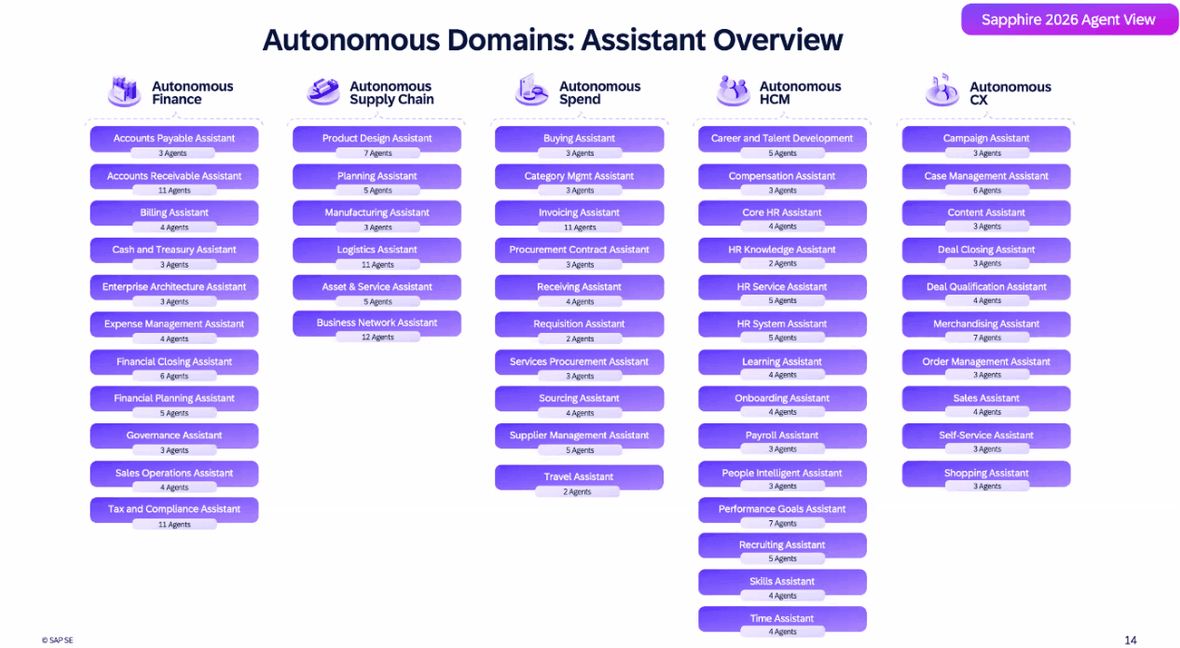
But how do you bring the classic enterprise world and AI together? And how far can SAP already fulfil its vision? This is precisely where a reality check is worthwhile from our perspective.
The vision: AI will become part of everyday work
SAP made it very clear at Sapphire 2026 where the journey should lead. Joule is evolving from a classic assistant into a central interaction layer. Specialised AI agents are to take on tasks in various business areas and collaborate with one another. SAP speaks of more than 40 specialised agents and over 2,400 Joule skills across numerous SAP solutions.
The long-term goal: Users should no longer have to switch between different applications and transactions, but rather initiate tasks through natural language. Joule and specialised agents orchestrate the necessary steps in the background to create an increasingly autonomous enterprise.
The reality: A long way still lies ahead of us
As exciting as this development is: A look into existing corporate landscapes shows that there is still a long way to go for companies to reach this vision. According tothe DSAG Investment Report 2026only a small portion of the surveyed SAP customers are currently using the SAP Business AI Platform productively. At the same time, many AI-active companies today primarily use non-SAP solutions, such as Microsoft Copilot.
This is hardly surprising. Microsoft technologies are already deeply embedded in the daily work of many companies. Copilot is therefore often one of the first touchpoints with generative AI. Additionally, there is the existing SAP landscape. ERP systems have been customised to individual requirements over ten, twenty, or more years. Processes have been expanded, in-house developments created, and additional systems integrated. Some companies are in the midst of the S/4HANA transformation, while others are still partially working with ECC.
The 'Autonomous Enterprise' therefore does not appear as the next step for many companies, but possibly as the step after next. However, this does not mean that companies should wait with AI.
The journey is the goal
As appealing as the comparison between vision and reality is – from our perspective, it would be too simplistic to pit today's system landscape against the SAP vision and dismiss the Autonomous Enterprise as 'unattainable'. The crucial question is rather: How can companies sensibly transition from their current reality to the AI vision?
This is precisely where we see our role as an SAP partner. Simply put: We must meet companies where they currently stand, while simultaneously creating an architecture that enables future developments.
This does not mean developing an Autonomous Enterprise on the drawing board, but can, for example, mean:
- sensibly integrating existing SAP systems,
- using Microsoft Copilot where it is already established in daily work,
- simultaneously building SAP cloud and AI services,
- purposefully integrating Joule into suitable processes,
- and gradually creating the prerequisites for more agent-based scenarios.
We are talking about a pragmatic hybrid approach. Not everything existing needs to be replaced immediately. At the same time, however, every new investment should contribute to gradually making the system landscape more future-proof.
Copilot or Joule? Or what is actually the question here?
Let’s consider a simple example from our consulting practice. What we see here is that Microsoft Copilot and SAP Joule are often viewed as competing approaches. From our perspective, this view is too one-dimensional for many companies.
Both systems have their strengths: Copilot is already present where many employees work daily. Joule, on the other hand, has the SAP-specific context and is to be integrated ever deeper into business processes and SAP applications.
It becomes particularly interesting where both worlds interact. SAP and Microsoft are working on corresponding integration scenarios. In the end, it should not matter which assistant 'wins'. What matters is which combination actually makes a business process simpler, faster, or better.
This is also one of the biggest challenges of the current AI discussion. Too often, we still hear the question: 'Where can we now deploy AI?' Initially, a company should clarify where a specific problem exists, for which AI could make a measurable contribution to its solution.
So let’s take a step back and seek answers to some fundamental questions such as…
...Where are manual efforts or media breaks occurring today?
...Which processes are suitable for AI support?
...What data is required and in what quality is it available?
...Which existing SAP and non-SAP systems need to be considered?
...How will we ultimately measure whether the initiative was truly successful?
These questions should precede the decision for a technology. And those who can provide clear answers will quickly realise whether Joule, Copilot, embedded AI, agents, or a combination thereof fits best.
Conclusion: A coherent vision that takes time
We fundamentally consider the SAP vision around Joule, agents, and the Autonomous Enterprise to be coherent. AI delivers the greatest benefit in a corporate context when it is not an additional application alongside existing processes but is directly integrated into them.
However, it will take time before this vision becomes widespread reality. For companies, this means neither waiting nor immediately following every new AI trend. The more sensible path lies, as so often, in between: It is about understanding the vision, realistically assessing one’s own starting situation, and beginning where concrete business impact is already possible today.
On this basis, a step-by-step AI roadmap can be developed that is not only based on a good demo but also works in the reality of one’s own company. With our SRB AI Discovery Service, we are happy to support you. How? Just ask me atai@srb.at
for more information.


