
UI in Focus – and what that means for Backend and Frontend

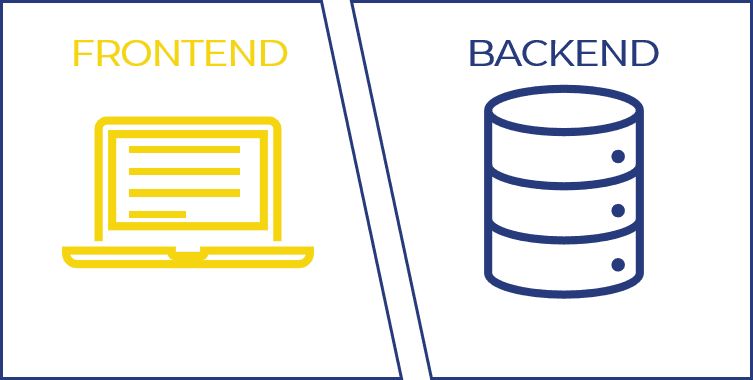
The development of non-standardised solutions requires a high degree of personal responsibility, organisation, and quality assurance. How we ensure this and contribute to successful projects is the content of this blog post.
“Without Backend, no Frontend” – I often hear this in my projects, mainly in the development of non-standardised solutions. And to be honest: Of course, corresponding client/server applications need a part that takes care of data processing. Circumstances that demand a great deal of know-how on the backend side. It seems to me a true impossibility for a single developer to comprehensively master all possible business processes – be it Warehouse Management, Supply Chain Management, Maintenance, or Work Clearance Management.
Accordingly, we at SRB strongly advocate the strategy of dividing expertise among several developers. The result: One project, diverse responsibilities. This makes communication and quality assurance all the more important. They are the be-all and end-all in such projects. But who leads?
Backend should follow Frontend
Thus, I find myself at SRB as the contact person for the implementation of customised solutions in web and user interface. I have seen many projects, managed many projects. Not only, but also specifically from this experience, I hold the view: The Frontend sets the direction.
In the implementation of applications with a user interface, it must therefore be “UI first”. This means that all processes and components of an application are adjusted to create the optimal user experience. Simply put: In the end, it is the person, the individual employee, who uses an application, and it is their usage that brings it to success. Or, from a project perspective, put differently: The Backend adapts to the Frontend, not the other way around.
Essential interplay
“UI first” is the mantra during development, but also in quality assurance. However, it must also be clear: A software project is not an IT dictatorship of the Frontend. The Backend does follow the Frontend, but both parts must, of course, work seamlessly together. One cannot exist without the other. There needs to be an exchange about development status, wishes, and possibilities. Continuous, agile project execution and ongoing communication come to the forefront.
Communication and development under control
But how do we ensure that projects run in a structured and controlled manner? Some development tools help us with this. If circumstances allow, we useGIT as a version control system. In the web environment, this has been a widely used and popular tool for decades. Even in the SAP/ABAP environment, GIT is gaining increasing importance.
The special advantage here: GIT allows us to version our source code across Backend, Middleware, and Frontend. Packaging code states also becomes child's play. This enables us to create and distribute application versions cyclically.
Thorough, automated testing and comprehensive documentation as success factors
Automated recurring tasks are now indispensable in a modern development landscape. They are essential, especially in times of ever-accelerating development cycles. Therefore, we rely on Continuous Integration, or CI, for recurring tasks that contribute to quality enhancement. More specifically, we use CI to regularly and automatically execute so-called “Build Tasks”.
Quality assurance is very essential to us. Therefore, our source code is also cyclically checked by automated “Build Tasks”. This allows any performance issues, syntactic errors, or compatibility problems to be quickly and easily identified and resolved, even before a corresponding application causes headaches and frantic activity during later troubleshooting.
We can also represent integration tests using our CI tools. This optimises testing efforts, lead times, and of course costs.
Also of utmost importance for both developers and clients: Clean documentation. Here, too, automation through CI comes into play. Parts of our application documentation are generated automatically.
Correct development environment improves outcome
The topic of “development environment” has become very diverse over the last five years. In the ABAP environment, we have been relying on Eclipse for some time. However, innovations are also on the horizon in this area according to SAP's strategy.
In the UI5 environment, we currently rely on SAP Web IDE Fullstack due to the widespread adoption of the technology among our clients. If circumstances allow, we also use Microsoft’s Visual Studio Code. SAP provides official plugins for this.
The advantage of MS VS Code is its openness to source code. This allows all available plugins to be installed, which in turn accelerates development. Generally, the more comfortable development is for a developer, the greater and more successful the outcome, and thus the quality and lead time.
Success through expertise and know-how
All these coding tools help us implement projects smoothly for the client. With a clear focus: UI in focus, Frontend in the lead, Backend in view. And as already mentioned: In the end, it is not the tool that determines a good or bad application, but always the person. The one who programmes, and the one who uses the resulting software development. A toast to expertise, a toast to know-how.


