
Prefer ODATA over SAP GUI?

Admittedly, it is difficult to compare apples and oranges, as OData describes a protocol, while SAP GUI is a program for working with SAP systems. Is the comparison flawed, or is there more to it?
Contrasting and comparing OData, short for Open Data Protocol, and SAP GUI, short for SAP Graphical User Interface, is unusual. However, there are reasons for this. Reasons that primarily stem from SAP GUI and the challenges associated with it. Classic SAP GUI programs often have the 'flavour' of being confusing and inflexible. Usually, the routines for retrieving or storing data are so tightly coupled to the program that they cannot be reused.
For example, if a simplified version of a program is needed, existing source codes often have to be copied and subsequently maintained in multiple places. Additionally, functions provided by the program are difficult to automate or connect to other tools or workflows.
OData addresses SAP GUI challenges
This is precisely where OData comes into play. The protocol, which is based on HTTP, can be used for a unified access to the backend, in this case, the SAP system. With the help of metadata, the available 'functions' can be read automatically. Based on this metadata and the provided options, new Fiori or UI5 apps can then be implemented for users.
If we revisit the comparison with SAP GUI at this point, we now have two applications: applications in SAP GUI and UI5 apps in the browser. Both programs can be used, but the 'OData-UI5-Browser' variant brings several advantages: By using a clearly defined interface, the data model is decoupled from the user interface. Frontend and backend developments can be carried out independently of each other. The associated tests can also be automated, ideally. Furthermore, the separation between backend and frontend allows backend functions to be used by different apps without needing further adjustments to the backend.
OData in action
So much for theory. But what does it actually look like in practice? At SRB, we use SAP CATS, short for Cross-Application Time Sheet, for recording our activities. However, the standard transaction CAT2 is rarely used anymore, as we provide time tracking via OData service using ABAP RAP.
With the help of a self-developed UI5 app that is connected to the service, the app is practically available across different device classes, regardless of the operating system, and can thus be used on classic desktop computers as well as on smartphones and tablets.
But I wouldn't be a proper developer if I didn't present a 'nerdy' variant. Therefore, I developed a small 'application' with a graphical UI for Linux, which allows time bookings via the OData service. The result is the program `andDogs`, specifically a Bash script that requires less than 100 lines. The script can be found onGitHub in the repository srb/srb_anddogs.
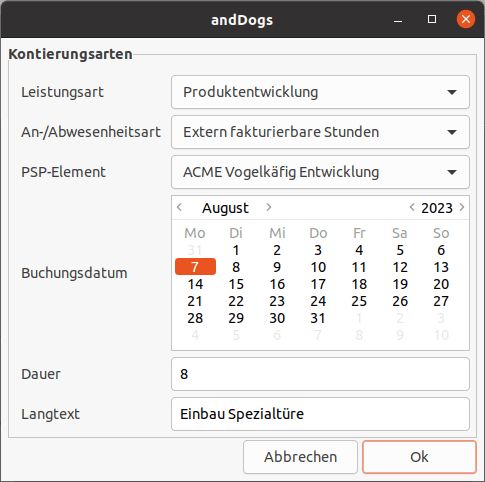
This alone shows: With sensible interfaces to the backend, new or additional programs can be implemented relatively quickly. While the initial effort may be higher compared to an SAP GUI development, one is certainly more future-proof with open OData interfaces.
Thus, apps in browsers offer many possibilities that are difficult or impossible to implement in the classic GUI, such as interactive displays of machines or Bluetooth integration. With the help of web technologies like HTML5, WebGPU, and WebAssembly, the user experience can be catapulted to the next level. And yet, one is not limited to web applications, as native applications for Android or iOS can also access the OData services. In short: Open interfaces lead to a vibrant ecosystem of new applications that cater to various user types.
Why it is worth looking at OData and SAP GUI in conjunction
In the ever-advancing world of technology, the tools we use are often challenged by new approaches and possibilities. The apparent comparison of OData and SAP GUI may seem unusual at first, but it accurately reflects the status quo of today's SAP development landscape: While classic SAP GUI applications undoubtedly have their place and fulfil their role, OData as an advanced protocol opens up a world full of (new) potentials.
Experience teaches us that flexible interfaces like OData pave the way for innovations. Their ability to decouple backend functions from various apps allows for more agile development processes and cross-platform availability of applications. This not only gives development a new dimension but also enhances the user experience and opens the door to new, creative application possibilities that address the diverse needs of users.
Practical examples impressively demonstrate how the use of OData and UI5 apps in time tracking and beyond opens the door to a diverse ecosystem of applications. From operating system-independent UI5 apps to 'nerdy' Linux applications, they prove how thoughtful interfaces open new horizons.
In the choice between OData and SAP GUI, it is not about pitting one against the other, but about recognising and utilising the diverse possibilities that modern technologies offer. With OData and its advantages, we have a tool at our disposal that encourages us to go beyond traditional boundaries and usher in a new era of application development. It is up to us to seize these opportunities and actively shape the future of technology.


