
e-Invoicing in the EU: Why the Right Decisions Matter Now

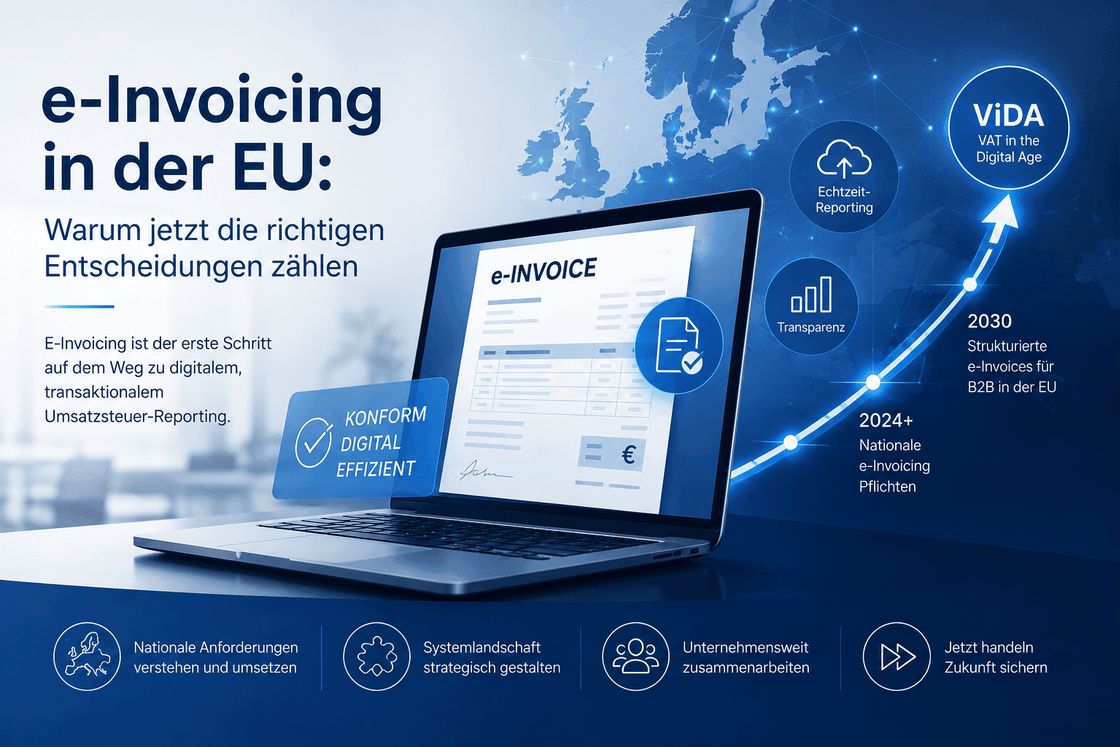
Electronic invoicing is here to stay. It is the central building block for the digitalisation of VAT reporting in Europe. Action is required now, and we explain why and what this means for you.
E-Invoicing is no longer a topic for the future. Modern companies have long recognised the benefits: e-Invoicing digitises the entire invoicing process, automates and accelerates workflows, and thus reduces costs. It also aids in compliance with tax and regulatory requirements.
This is where the wheat is separated from the chaff: Many companies still view e-Invoicing as an isolated regulatory requirement. In reality, it is part of a larger development, the target image of which is often misunderstood.
Two developments, related but staggered
But first, let us look at the background. Currently, two closely linked developments are taking place in the EU:
- National B2B e-Invoicing obligations (today & short-term) More and more countries are introducing mandatory electronic invoices in the B2B sector, similar to the EU-wide rules for the B2G sector in the past. Depending on the country, these are either already implemented or in preparation.
- ViDA (VAT in the Digital Age) as a strategic EU target image
ViDA describes the long-term transformation towards EU-wide, transactional VAT reporting in digital form.
It is important to note that these two developments are not identical and do not occur simultaneously.
Inconsistent solutions in the EU
In many EU countries, e-Invoicing is already a reality or just about to be introduced.
Currently, country-specific models are emerging, which are characterised mainly by the following:
- different formats
- different platforms (e.g. Peppol, clearance systems)
- different reporting requirements
This means that electronic invoices are being introduced, but they are not automatically linked to real-time reporting. Whether and how invoice data is transmitted to tax authorities currently depends on the respective country.
ViDA: unified real-time reporting as a long-term goal
ViDA aims to address this. With this initiative, the EU pursues a clear goal: unified, digital, and transaction-based VAT processes.
Specifically, this means the exchange of transactional data in (almost) real-time. Traditional reports, such as the summary report, are to be replaced, using structured e-Invoices as the data basis. However, this will not happen overnight. The EU aims to approach this target image step by step, rather than implementing it by a deadline.
According to current planning, the mandatory use of structured e-Invoices for intra-community B2B transactions at the EU level is only planned for 2030.
Why acting now can still be crucial
Even though ViDA as a whole seems to lie far in the future, action is required now. Because it holds true: Without e-Invoicing, this goal is not achievable!
Electronic invoices are simply the prerequisite for:
- structured data to be available
- automated processing to become possible
- and reporting processes to be digitised.
In other words: e-Invoicing is not the end goal, but the necessary first step.
A common misconception that we at SRB encounter with clients across the country is the assumption that the entire EU system will be switched over by 2028. What is true is that B2B e-Invoicing obligations will indeed become relevant around this time in many countries. However, implementation will occur in phases and country-specific. Furthermore, ViDA will go far beyond a complete reporting model.
The logical consequence: Companies must prepare earlier, even if individual regulatory obligations come into effect later.
Local solutions vs. strategic architecture
The biggest challenge for companies is therefore not a uniform EU regulation, but rather a multitude of national requirements.
This leads to central questions:
- How can different country requirements be efficiently mapped?
- How can parallel individual solutions be avoided?
- How can the system landscape remain maintainable?
Companies must therefore not only implement e-Invoicing but also design it strategically. Reacting to this challenge with local solutions in the short term is insufficient. Typical consequences include increased complexity, higher costs, and a lack of scalability. A sustainable approach therefore means standardisation across countries.
Another important point that many underestimate: e-Invoicing does not only concern the tax function, but is a company-wide issue. It affects Finance (reporting, processes), IT (architecture, integration), Operations (document flows), and Compliance. Thus, it becomes a transformation project across multiple areas. An end-to-end integration into the ERP landscape is therefore urgently necessary – and this is associated with the use of central platforms.
Now lay the foundation for what is to come
The central question is no longer whether companies must implement e-Invoicing – but how. A future-proof approach should be based on standard solutions (e.g. SAP DRC), avoid creating isolated island solutions, and cover the entire process: from the document to the e-Invoice and reporting to the submission to the authority. Only in this way can current requirements be met and future developments integrated.
The path to ViDA begins todayand e-Invoicing is the first concrete step. Companies that only react singularly now are building complexity. Companies that plan strategically create a scalable foundation. The crucial question for you is therefore: Do you react to requirements or design your architecture for the future? We at SRB are happy to assist you.


