
SRB goes SAP S/4HANA, Part 4: When it runs, it runs!

Our move was an exciting journey. And once we reached the destination, it was time to enjoy. As much as one can say that about SAP. Because in the run phase, you draw from what you invested in time and effort beforehand. Here are a few tips.
Our move to SAP S/4HANA was an exciting journey. And once we reached the destination, it was time to enjoy. As much as one can say that about SAP. Because in the run phase, you draw from what you invested in time and effort beforehand. Here are a few tips.
Wonderful. We were at the destination, thesystem deployed, the data migrated. Theintensive preparatory work and the testing had paid off. Apart from a few minor issues, everything ran smoothly! Therefore, here are some general information and tips for the final phase of our journey that we want to share with you.
Run Phase – points to consider
Verification of system stability:
- Continuous monitoring of system performance, errors, and downtimes
- Identification and resolution of bottlenecks or weaknesses
Process optimisation:
- Analysis of actual usage and processes in productive operation
- Adjustment and fine-tuning of business processes and user interfaces
- Incorporation of feedback from end users
Further development of the solution architecture:
- Review of the scalability and extensibility of the solution
- Integration of additional functions and extensions
- Adaptation to changing business requirements
Ensuring compliance:
- Continuous review of compliance with regulatory guidelines
- Implementation of new regulatory requirements
- Conducting audits and certifications
Knowledge management and training:
- Documentation of the solution and processes
- Regular training and further education for users
- Building internal know-how and expertise
Continuous improvement management:
- Collection and prioritisation of improvement suggestions
- Implementation of optimisations and further developments
- Incorporation of feedback from users and stakeholders
Operating model and support structures:
- Adjustment of the operating model to new requirements
- Establishment of appropriate support and escalation processes
- Coordination between IT operations, departments, and external service providers
Continuous monitoring, optimisation, and further development of the SAP S/4HANA solution are crucial to realise the full benefits of the investment and ensure acceptance among users. For the conversion is not the end. With various innovation projects, it continues towards the digital core.
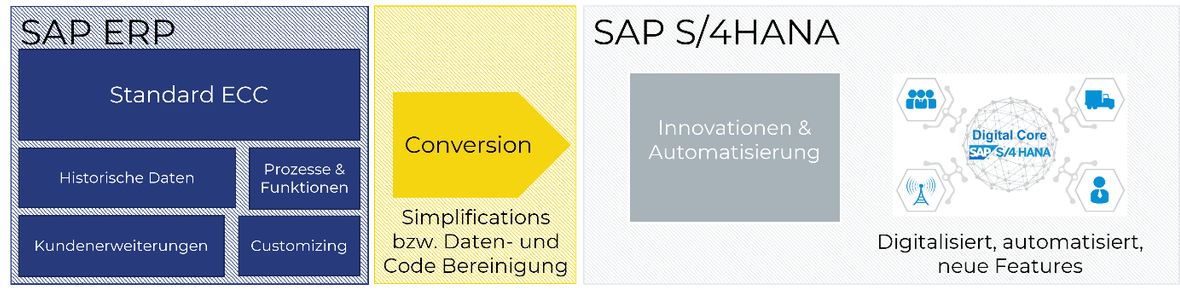
Since some of the topics of the run phase also overlap with the post-project phase, we have decided not to separate them in this contribution. Below are some additional topics that may need to be considered in both the run phase and the post-project phase during an SAP S/4HANA implementation:
Settlement Management / Bonus processing in SAP S/4HANA
In SAP S/4HANA, bonus processing has been fundamentally revised and simplified. Key changes include:
- Integrated processes:Bonus programmes are now seamlessly integrated into the core processes of S/4HANA. This enables continuous processing of bonus information across the entire value chain.
- More flexible configuration:The bonus logic can be configured much more flexibly in S/4HANA. Companies can define individual rules, calculations, and payment modalities to implement customised bonus programmes.
- Real-time evaluations:By using HANA technology, bonus information can be evaluated and visualised in real-time. This allows for better monitoring and quicker responses to market changes.
- Improved compliance:Bonus processing in S/4HANA better considers current regulatory requirements and compliance guidelines than the previous solution.
To take advantage of these benefits, the following points must be considered when transitioning to SAP S/4HANA:
- Adjustment of existing processes:Companies must carefully analyse their existing bonus programmes and processes and adapt them to the new possibilities in SAP S/4HANA. This often requires a revision of business rules and data structures.
- Data transfer and cleansing:The transfer of existing bonus data into SAP S/4HANA must be carefully planned and executed. Often, cleansing and harmonisation of the data is necessary. Migrate the bonus processing step by step into SAP S/4HANA. Test the new solution thoroughly before going live.
- Employee involvement:The transition to the new bonus processing has significant impacts on employees. Early involvement and training are crucial for a successful implementation.
- Testing concept and quality assurance:Extensive testing of the new bonus processes is necessary to avoid errors and ensure compliance with guidelines.
- Continuous optimisation:Continuously adjust the bonus logic in SAP S/4HANA to changing requirements. Utilise the flexibility of the new solution.
Overall, bonus processing in SAP S/4HANA offers significant improvements over older ERP solutions. With the right preparation and implementation, companies can benefit from these advantages.
Credit Management (FSCM)
FSCM (Financial Supply Chain Management) is an integrated solution in SAP S/4HANA that simplifies and optimises credit management. It offers enhanced functions for credit checks, credit limit management, dunning, and collections. FSCM is closely linked with other modules such as financial accounting, sales, and materials management, providing a holistic view of the financial cycle.
Central functions:
- Automated credit checks:Integrated connection to external credit agencies for quick credit assessments
- Enhanced credit limit management:Dynamic adjustment of credit limits based on financial metrics and transaction history
- Improved dunning:Automated dunning runs, escalation scenarios, and collection management
- Reporting and analyses:Integrated dashboards and reports for comprehensive credit management
Transition aspects:
- Adjustment of existing business processes:Review and adjustment of processes such as credit checks, credit limit allocation, and dunning
- Data migration:Transfer of existing credit data into the new FSCM structure
- System integration:Coordination and connection of FSCM to other relevant systems (e.g., financial accounting, CRM)
- Training and change management:Comprehensive training for employees and support during the change process
- Customising and adjustments:Adjustment of the FSCM configuration to company-specific requirements
Benefits for companies:
- Increased transparency and control in credit management
- Improved liquidity through more efficient receivables management
- Reduced manual effort through automation
- Better decision-making bases through integrated analyses
- Stronger integration with other business areas
In summary, FSCM in SAP S/4HANA offers a powerful and integrated credit management tool that helps companies optimise their financial processes and improve liquidity. However, careful planning, adjustment of business processes, and effective change management are required to fully leverage the solution's benefits.
Intrastat
The Intrastat reporting in SAP S/4HANA has fundamentally changed compared to older SAP ERP systems. Therefore, it is important to understand the innovations and the associated challenges during the transition.
Key changes include:
- Simplification of the architecture:The previous transactions for Intrastat processing (e.g., VI91, VI92) are obsolete. Instead, reporting is done via the 'Manage Intrastat Declarations' app.
- Master data maintenance:The maintenance of Intrastat-relevant master data, such as commodity codes and country of origin, is now done in central master data management using a Fiori app.
- Simplified correction options:Incorrect reports can be corrected directly in the app and re-reported.
- Real-time reporting:With the direct integration of the Intrastat functionality into S/4HANA, Intrastat reports can be created and submitted in real-time. This improves data quality and allows for timely compliance with legal requirements.
- Expanded data model:The data model for Intrastat processing has been expanded and optimised. It now includes additional fields and characteristics relevant for Intrastat reporting. During the transition, the data structures must be adjusted and migrated accordingly.
- Configuration and customising:The configuration and customising of Intrastat processing are done directly in SAP S/4HANA. It is important to understand the new settings and parameters and configure them according to the company's requirements.
- Integration with other modules:Intrastat processing is closely linked with other modules such as sales, purchasing, and logistics. During the transition, the interfaces and dependencies with these modules must be considered and tested to ensure smooth integration.
- Training and change management:The transition to the new Intrastat processing requires appropriate training for employees in the affected departments. It is important to conduct effective change management to ensure acceptance and understanding of the new processes and functionalities.
- Testing phase and validation:Before the productive transition, a thorough testing phase should be conducted to validate the correct functioning of the new Intrastat processing. Real business processes and scenarios should be covered to identify and resolve potential errors or inconsistencies early.
- Legal requirements:Intrastat processing is subject to legal requirements and regulations. It is important to be aware of the current regulations and ensure that the configuration and generated reports comply with legal requirements.
The core question arising from these changes is: What challenges are there during the transition?
- Data migration:Historical Intrastat data must be migrated to the new data model.
- Adjustment of processes:Existing processes for Intrastat reporting must be adjusted to the new architecture.
- User training:Users must be trained in using the new app.
- Integration with other systems:Existing interfaces to other systems (e.g., customs authorities) must be reviewed and adjusted if necessary.
I also have a few tips and notes to ensure everything runs smoothly:
- Early planning:The transition should be planned early, allowing sufficient time for migration, process adjustment, and training.
- Data quality:The quality of master data and transaction data is crucial for successful Intrastat reporting.
- Testing phase:A testing phase should be conducted before going live to ensure the correct functioning of Intrastat reporting.
- Monitoring:After the transition, Intrastat reporting should be regularly monitored to identify and resolve errors early.
S/4 Embedded Analytics
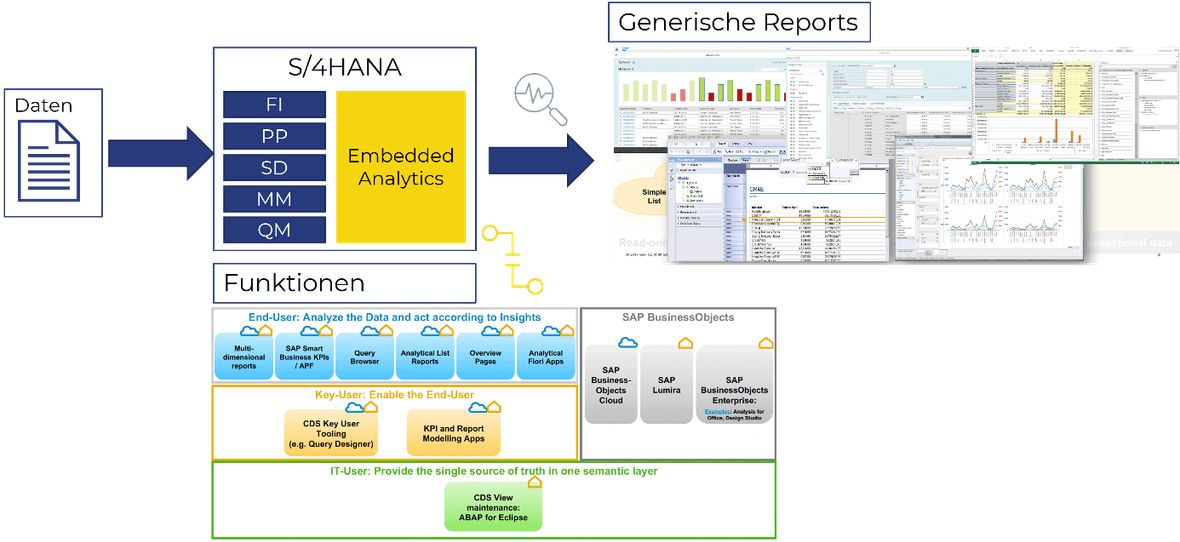
S/4 Embedded Analytics is a new reporting concept in SAP S/4HANA and is essentially the successor to the outdated SAP Report Painter reports. It benefits from the fast HANA database and the new Fiori interface. Based on the SAP S/4HANA base tables, a virtual data model (VDM) is provided via CDS views. Evaluations are thus performed live on the database and do not need to be separately persisted as in a data warehouse like SAP BW.
For most applications, corresponding views are already provided in the standard. Users can also create their own evaluations either manually using the modelling tools from Eclipse or via the Fiori app.
The presentation of reports can then be done either through analytical Fiori apps or through the SAP Analytics Cloud for more complex evaluations, which, however, must be separately licensed for on-premise systems. Otherwise, no separate licenses are required for S/4 Embedded Analytics.
An important question that arises in this context is: Will a DWH like SAP BW become obsolete? The answer: Not entirely. Certain requirements still necessitate a DWH like SAP BW or SAP Datasphere. Examples include linking various data sources from other systems (SAP / Non-SAP) or when snapshots/frozen datasets or complex ETL/transformation processes are required.
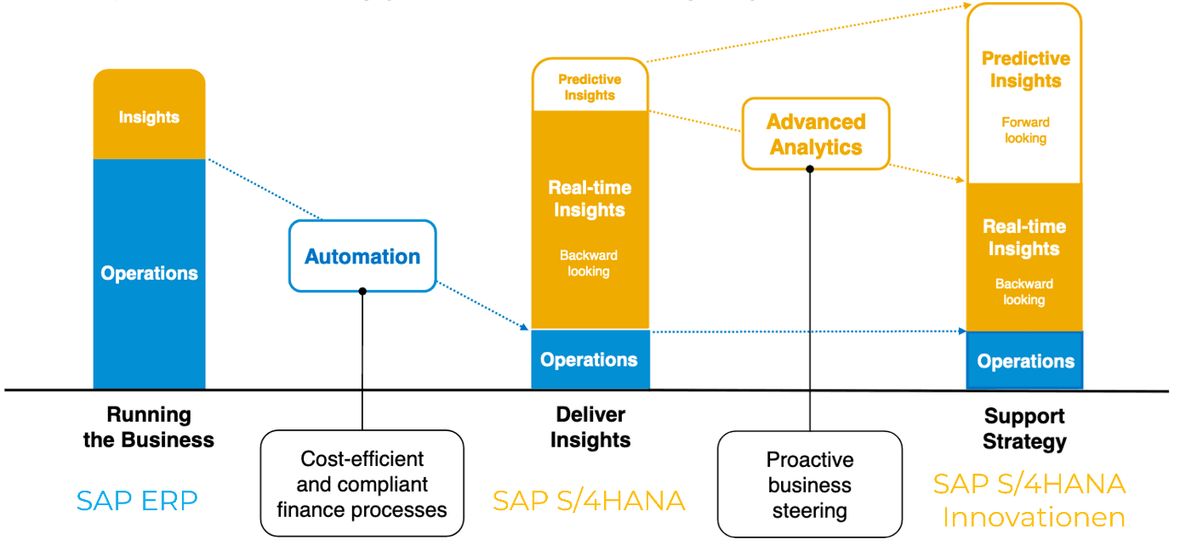
Embedded Analytics is not the only highlight in the finance area.SAP's vision of finance transformation encompasses much more. However, it would exceed the scope here. From daily routines to supporting growth and forward-looking insights, everything is covered.
EWM / Advanced EWM
SAP Extended Warehouse Management (EWM)
EWM was originally a separate module within the SAP Supply Chain Management (SCM) suite and ran on its own machine, connected via an interface to an SAP R/3 system or another ERP. With the transition to SAP S/4HANA, EWM has been integrated with all functions into the ERP. What has not changed: The module still communicates with the other ERP modules via internal interfaces. This means, for example, that the material master must be maintained in a separate transaction and deliveries for all goods receipts and issues are required.
While technically all functions are also included in SAP S/4HANA, EWM is licensed in Basic EWM and Advanced EWM. While Basic EWM is included in the license for the SAP Business Suite, Advanced EWM must be licensed separately. Basic EWM includes all basic warehouse functions, while Advanced EWM includes additional functions such as:
- Cross Docking
- Yard Management
- Labor Management
- Warehouse Automation (MFS)
- Slotting
- Value Added Services/Kitting
Warehouse Management & Stock Room Management
While EWM is the strategic product for warehouse management in SAP S/4HANA, it was originally planned to phase out Warehouse Management (WM) by the end of 2025 (see Compatibility Mode Matrix in the notes2269324 and 2270211). Presumably due to the intervention of several customers, SAP has since revised this decision. Therefore, WM will continue to be phased out but will be replaced by the Stock Room Management module. This includes the same functions as its predecessor, except for:
- Task & Resource Management (WM-TRM)
- Warehouse Control Unit Interface (WM-LSR)
- Value Added Service (WM-VAS)
- Yard Management (WM-YM)
- Cross-Docking (WM-CD)
- Wave Management (WM-TFM-CP)
- decentralised WM (WM-DWM)
Thus, these are largely the functions that would need to be licensed separately in EWM. For basic warehouse management in SAP S/4HANA, this means that a choice must be made between WM and EWM. However, it should be noted that SAP clearly communicates that there will be no new developments for WM or Stock Room Management and that EWM is the strategic product. Stock Room Management is therefore intended for existing customers with WM, allowing them to migrate more easily to SAP S/4HANA and continue using their existing WM solutions beyond 2025.
Additionally, it should be mentioned that while WM can still be used, this does not apply to other closely integrated modules. The transport component LE-TRA is particularly noteworthy, which will continue to be phased out in 2025 and will be replaced by the Basic Shipping solution in SAP S/4HANA.
Advanced ATP (aATP) – Intelligent Order Confirmation
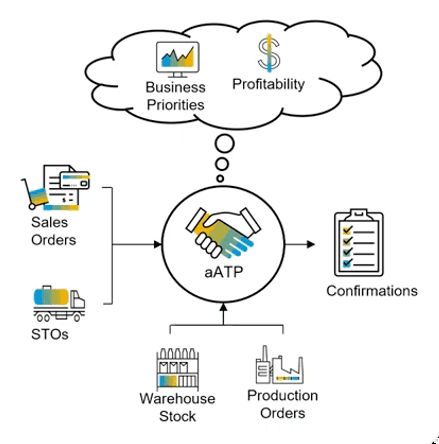
As an important and integral part of the order fulfilment process, SAP S/4HANA aATP provides accurate and reliable order confirmation data considering the relevant stock in real-time. At the same time, it takes into account the business priorities and profitability goals of the company.
Fiori in Sales
In the learned SAP practice, the majority still works in SAP GUI with well-known transactions. Simple examples in ourblog post show: The apps are on the rise to take over. With noticeable advantages. To what extent they will prevail and which ones will remain, the future will show.
SAP Production Engineering and Operations (PEO)
Subsequently, it is also possible to introduce Extended PEO. For us, this was not necessary. Nevertheless, it should not be omitted in this enumeration. SAP PEO is a seamless process from product development to manufacturing execution, encompassing the following functionalities: a unified data structure of design and manufacturing data, unified and overarching change management, and detailed manufacturing control and monitoring.
Benefits include, among others, having more options to represent the manufacturing process transparently, as well as detailed control, better representation of complex assemblies, and the possibility of different master data structures. However, it should be noted that it is not yet fully matured and licensing costs must be paid per base user.
Intelligent Asset Management
Topics such as predictive maintenance & service must not be forgotten here either. Based on sensor data, statements about maintenance activities are made.
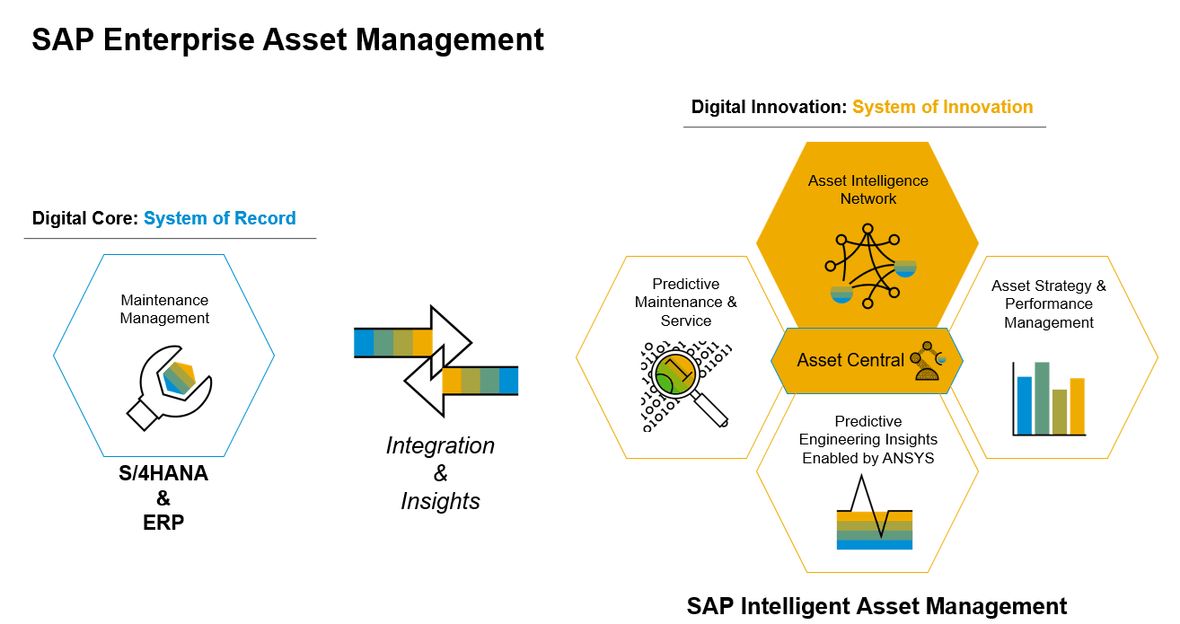
In ourblog area 'Maintenance' you can find out more about it.
An exciting journey comes to an end
So what can we conclude? What have we taken away from this journey to SAP S/4HANA, what have we learned?
Essential for success is to involve all affected parties from the beginning and to get a clear picture of the current and desired situation. We also took the opportunity to get rid of some legacies or to improve something.
It is also advantageous to have a clear vision of where to go in the future and, with this vision in mind, to make clear decisions about where to invest immediately and where to take more time or even hold back.
We invested a lot of time in preparations and details. In the end, it paid off. Therefore, anyone facing an SAP S/4HANA transition should keep this in mind.
And last but not least, we can also pat ourselves on the back a little. We were really well positioned with our team. We were able to fully utilise all our expert knowledge that we put into this project, making the transition as smooth as possible for everyone. With the right people in the right places, nothing stands in the way of a smooth conversion. You should also keep this in mind. And if it were: We are happy to be available for you 😉.
Additional information
If you are also facing migration to SAP S/4HANA or have questions about our journey to the new platform, simply contact me. Additionally, I have compiled interesting additional information with further and hopefully helpful tips & tricks regarding the previous phases of the transformation journey.Info sheet 1: Strategies & Methods Info sheet 2: Preliminary projects
Interested in all episodes of the SAP S/4HANA migration at SRB? Find all previously published contributions on the following phases here:
