
SAP Sales and Service Cloud V2: Is the Switch Worth It?


Since 2023, SAP has been offering the Sales and Service Cloud V2, with new releases continuously coming out. But is the switch worth it? We take a closer look and show how it differs from the previous version and what opportunities it offers.
Since 2023, SAP has introduced the latest generation of the Sales and Service Cloud, version 2 (V2), in its portfolio – with new releases continuously being rolled out. But is the switch worth it? We take a closer look and highlight the key differences from the previous version and the opportunities available.
SAP C4C used to be the benchmark for cloud-based sales and CRM solutions. It also served as the foundation for the Sales and Service Cloud. SAP has retained core functionalities such as the lead-to-order process and the 360-degree customer view, but has developed far beyond a simple update.
However, many customers have so far shied away from making the switch. But the pressure is mounting. Given the enhanced functionalities of the SAP Sales and Service Cloud V2 and the increasingly brief release notes of the previous version, the question arises: Is it now worth switching to V2?
To answer this question, we need to delve deeper and examine what the SAP Sales and Service Cloud V2 can do – and what it perhaps cannot.
The Architecture
The SAP Sales and Service Cloud V2 is a cloud-native application that employs a microservices architecture. Unlike the monolithic architecture of its predecessor, the loosely coupled services can be developed, deployed, and scaled independently.
This is a significant advantage, as it positively impacts performance, promotes reliability, and allows for a more flexible approach to updates. This is particularly beneficial in today’s rapidly changing IT environments. Thanks to the redesign of technological standards in the CRM software landscape, agility and flexibility can be further enhanced.
The Interfaces
Here too, the SAP Sales and Service Cloud V2 showcases its strengths. Integration principles based on Application Programming Interface (API) development enable better integration with external applications, a predefined master data integration with SAP S/4HANA, and mashup-based UI integration.
Additionally, there are several options for exporting or importing data to and from non-SAP systems. This includes the use of CSV files for data import/export, pre-built autoflows to trigger events on data changes in the V2 system, as well as REST APIs.
Integration with MS Teams is also standard. This feature has been frequently requested. Another bonus: The SAP Sales and Service Cloud V2 allows sharing and editing of deal rooms and workspaces directly in MS Teams, thus supporting not only outgoing calls.
The User Interface
By 2024, almost no one needs to be explained the importance of user interface and experience regarding applications. This is no different here. The goal in developing the new solutions was clear: UI and UX should simplify users' daily tasks and make them significantly more efficient. This is achieved in two key areas:
- Value Selection: There is no longer a need to navigate to separate search and selection screens. The function is integrated directly into the selection.
- Direct Field Editing: Fields can be changed by simply clicking, and relevant values can be selected or entered. Changes are automatically saved, making a 'Save' button unnecessary and saving an additional click.
This has been developed to ensure a stronger connection between objects. The result is smoother and faster navigation compared to the older version. Furthermore, the architecture allows multiple people to work on the same object simultaneously. This is an extremely significant advantage, as it helps avoid unnecessary emails or conversations and thus reduces waiting time in the future.
The Activity Manager
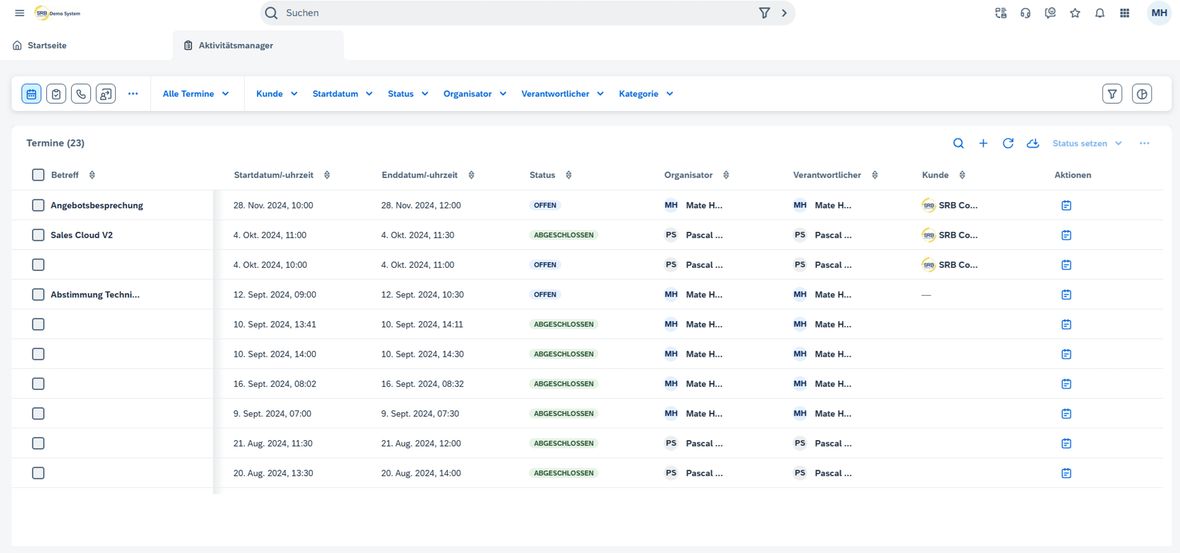
SAP has revamped its new central function – the Activity Manager – and taken it to the next level. Compared to SAP C4C, all activities such as tasks, appointments, calls, and visits can now be displayed on a single screen for editing from the same page. This was difficult to achieve in C4C. This makes it easier for sales to manage daily organisational challenges.
To further simplify sales life in the future, SAP plans to expand the use of AI here. For example, AI can already draft an email based on historical contact and account data or interactions, initiating the deeper sales process. On the other hand, we can generate personalised questions for a discovery call using AI, which can be utilised during the sales conversation.
However, there is a limitation: The AI functionality can only be used with the purchase of the SAP AI Unit licence.
The Digital Selling Workspace
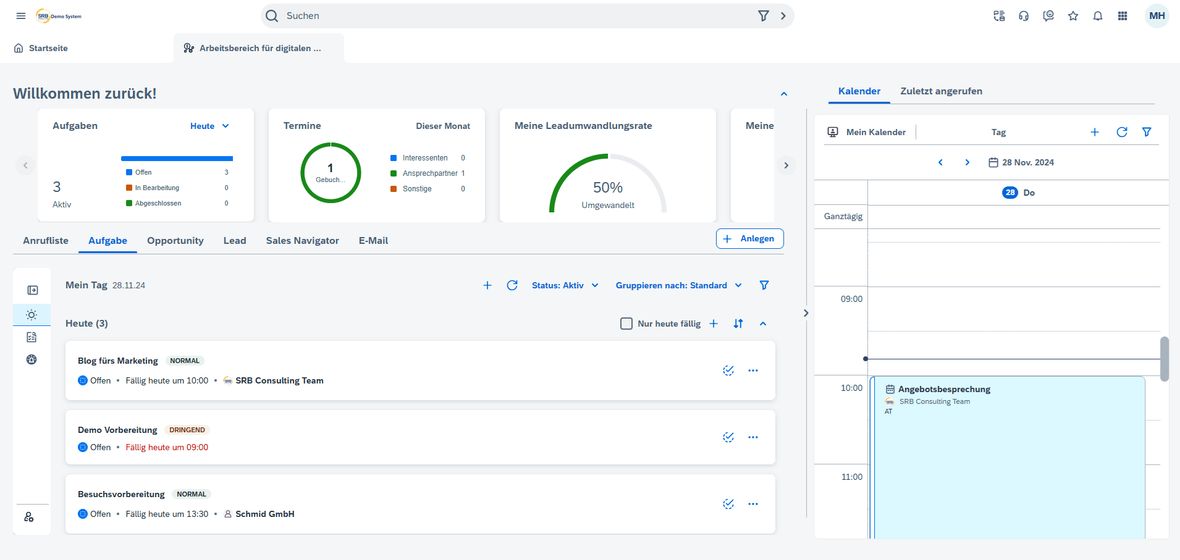
Nowadays, sales primarily occurs online. This has led to both a desire and a necessity to have an overview of all relevant, available content and functions at a glance, including KPIs, agenda, recently conducted interactions, tasks, leads, or opportunities.
This is where the Digital Selling Workspace comes into play. It aims to save time, reduce unnecessary navigation, and thereby increase productivity. This was lacking in SAP C4C. This was precisely what made daily life difficult for many C4C users, as they had to constantly switch between C4C windows.
Guided Selling
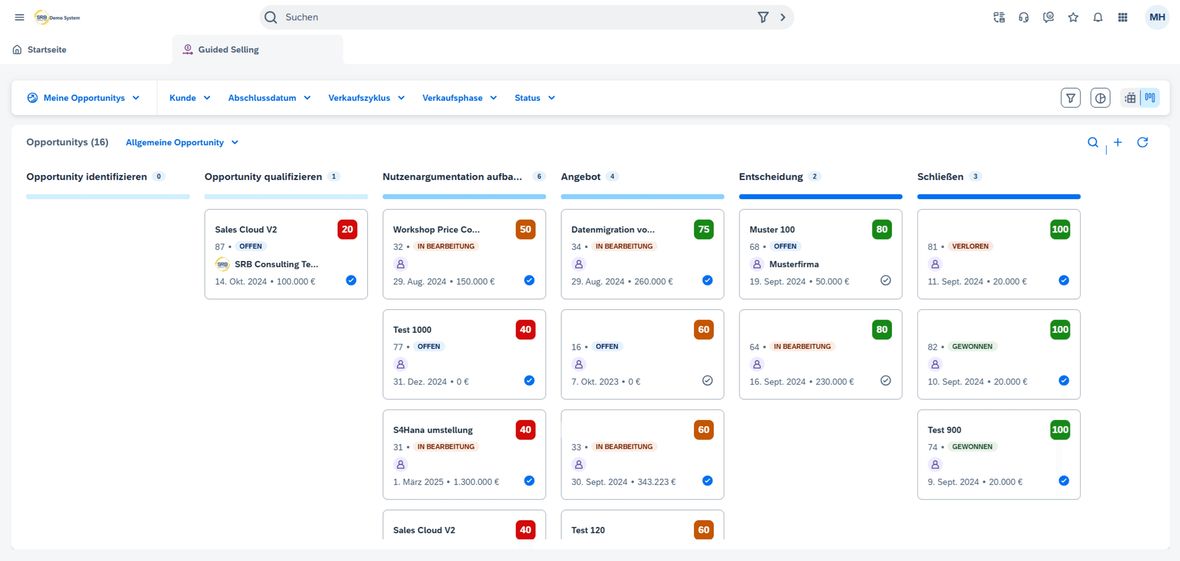
Guided Selling is not new; the concept is already known from SAP C4C. The difference now is that it is no longer an add-on solution but has been introduced as standard with the SAP Sales and Service Cloud V2.
As many have requested, the function offers an interactive Kanban overview of opportunities with numerous filtering and selection options. On one hand, opportunities can be dragged and dropped from one phase to another without leaving the detailed view of the opportunity. On the other hand, dynamic playbooks make the deal processing and closing process more efficient by automatically providing action recommendations for users.
The integrated machine learning option generally makes handling even easier. This includes lead and opportunity scoring, which calculates and assigns a rating based on activities and data. It also analyses the frequency and recency of email traffic and determines the strength of the customer relationship ('Relationship Strength') based on this information. Another advantage: Pricing has been significantly optimised compared to previous versions.
Case Management
In the SAP Sales and Service Cloud V2, the 'case' replaces the 'ticket' functionality from SAP C4C. This has also been revamped. The functions and information are now located on a single screen. A guided process also leads users to a quick resolution, resulting in higher productivity and efficiency.
Thanks to the integration of AI, it is possible to significantly reduce resolution time concerning the knowledge base and similar cases. AI can generate a comprehensive solution proposal based on the content of the knowledge base or previous cases. In this case, the user only needs to briefly check the email and can then easily send it to the customer.
Moreover, AI helps to better prioritise cases. Based on the input, AI estimates the customer's satisfaction level and assists users in prioritising the case accordingly. Even afterwards, AI provides support. It compiles all information into a summary that can later be used to resolve other cases. The summary can also be generated when the ticket is handed over from one processor to another. Additionally, users benefit from AI-supported checks, such as an automated language check including translations.
The Development
SAP has also changed its approach to development. In-app extensions such as UI customisations of layout, custom fields, validations, and mashups are available in the SAP Sales and Service Cloud V2 thanks to the architecture, but have been made more flexible compared to the previous version. The previously known SDK development environment is no longer available.
SAP is pursuing a new approach in development with 'No-Code / Low-Code' using SAP Build (also known as AppGyver). More complex extensions must therefore be newly implemented on the Business Technology Platform (BTP), where there are many programming options, such as side-by-side extensions. According to SAP, it is advisable to use the CAP (Cloud Application Programming) language. The development environment in the public cloud offers the advantage that a separate development environment with its own language is not needed specifically for CRM.
The Reporting
Reporting (Business Analytics), which is integrated into SAP C4C, is no longer available in the SAP Sales and Service Cloud V2. Instead, SAP uses SAP Analytics Cloud (SAC) as an option.
In the SAP Sales Cloud V2, 'Embedded SAC' can be used to represent reporting if one does not yet have their own SAC tenant. This would actually offer even more extensive options but also requires a separate licence. Therefore, during the transformation, it is advisable to check in advance which reports are necessary and whether they can be represented in the Embedded SAC.
The Conclusion: Switch with Much Potential, but Also Work
In summary, the SAP Sales and Service Cloud V2 represents a significant advancement. The modern architecture and AI-supported, innovative features stand out, leading to a markedly improved user experience and greater flexibility.
However, the decision to migrate should be based on a thorough assessment of the specific needs and readiness of the entire organisation. For those planning an SAP C4C implementation or a switch from CRM 7.0, it makes sense to opt for the SAP Sales and Service Cloud V2 right away. A switch is also advisable for companies that have implemented their SAP C4C with minimal PDI programming.
Companies with many PDI solutions in SAP C4C, on the other hand, must expect significantly higher effort. Additionally, the complex interfaces will largely need to be redesigned. Companies with a broad scope must therefore carefully consider whether the added value of switching from SAP C4C to the SAP Sales and Service Cloud V2 truly outweighs the effort. Accordingly, implementation can be postponed a bit.
One way or another, one thing is certain: The SAP Sales and Service Cloud V2 elevates work in sales and service to a new level. In the future, no company will be able to bypass it.

