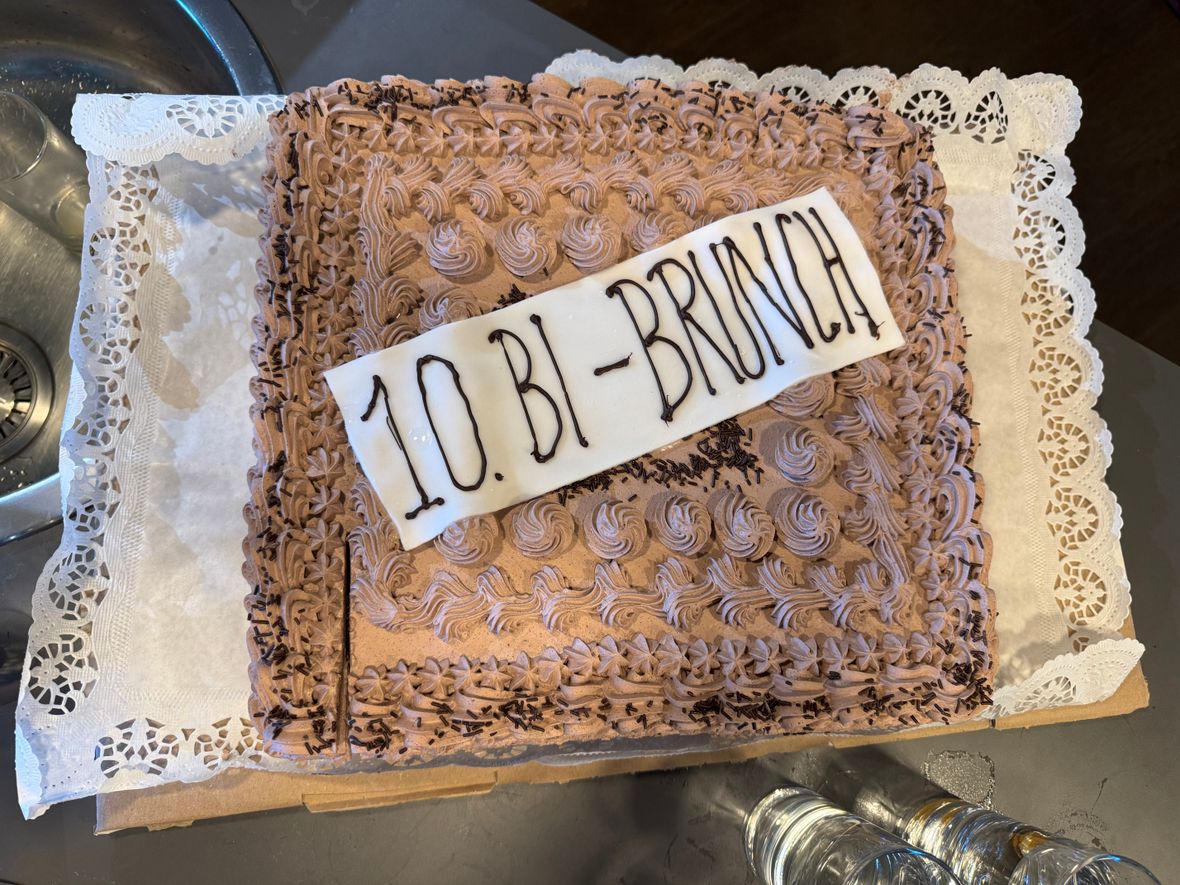
Anniversary with a Future Perspective: At the 10th BI Brunch, SAP Business Data Cloud Meets Business AI


For the tenth time, it was: BI Brunch – and for the anniversary edition, alongside the cake, an extra portion of future was served. The SAP Business Data Cloud Roadshow provided fresh impulses for data-driven corporate governance. The central question: How can existing BI and BW landscapes be made fit for the next chapter?
A round occasion, a full room, and plenty of topics for discussion: Around 70 participants gathered for the 10th SRB BI Brunch as part of the SAP Business Data Cloud Roadshow at SAP's premises. Together, we focused on SAP Business Data Cloud, Business AI, and modern planning with SAP Analytics Cloud – from strategic decisions to concrete insights into practice.
AI needs more than just a language model
The day, packed with information, kicked off with Elisabeth Nagel and Alexander Losbichler from SAP Austria. They provided an outlook on the SAP Business AI Platform with a central message: The success of AI depends not only on powerful language models but primarily on high-quality business data, business processes, and governance structures.
And because an anniversary edition offers not only food for thought but also a reason to celebrate, both were part of the 10th BI Brunch: the view on the next steps in data, planning, and AI as well as the joy over this round number. Between expert discussions and cake, there was enough space for what has characterised our BI Brunch since Episode 1: asking questions, sharing experiences, and engaging in conversation.
A heartfelt thank you to everyone who contributed to and celebrated this anniversary edition with us.
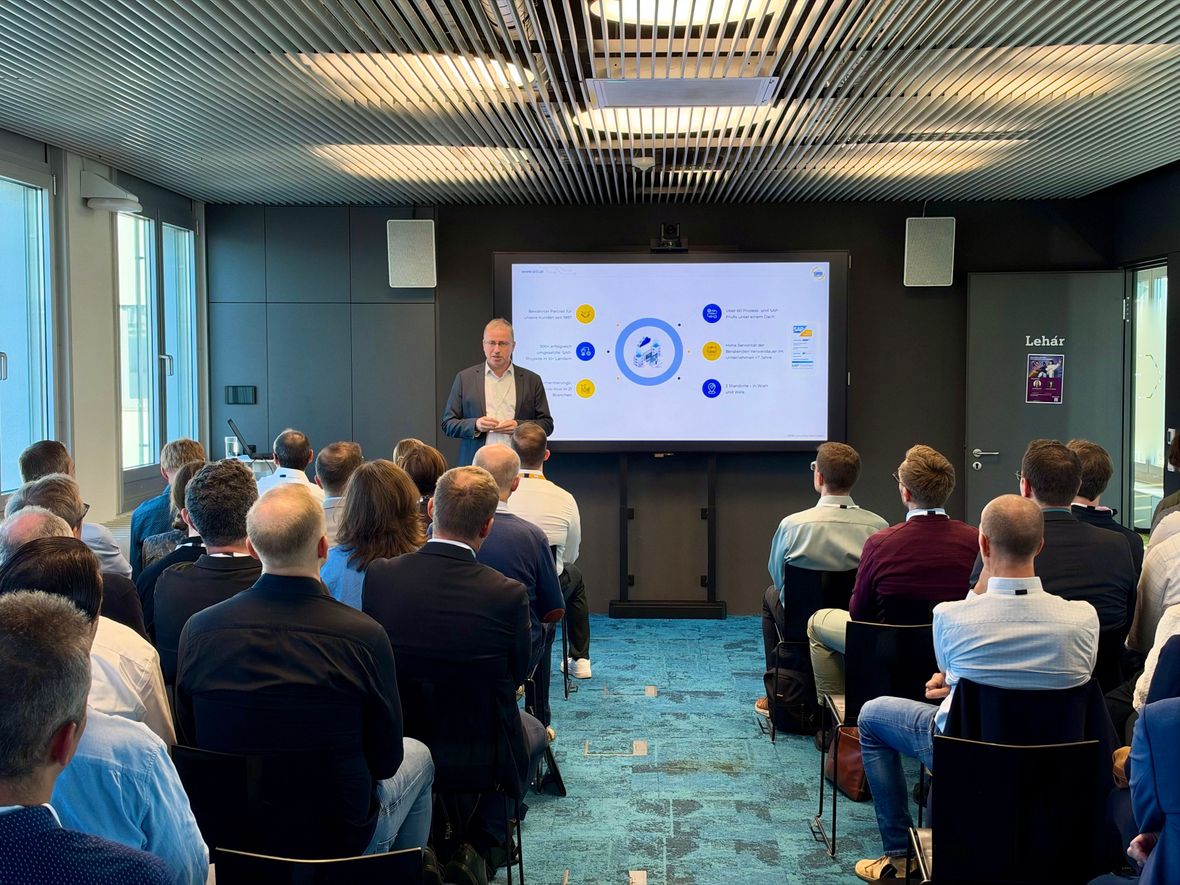
SAP relies on the SAP Knowledge Graph, which links business data with its contextual relevance. This way, AI agents should not only provide answers but also understand and support entire business processes. The vision ranges from the AI assistant Joule to agent-based processes that independently conduct analyses and trigger actions.
Planning: Less Excel, More Integration
Michael Königsmayr from Welser Profile demonstrated how modern corporate planning can look in practice. The starting point was a complex cost centre planning based on BW/4HANA and BPC, involving significant manual effort and numerous Excel side calculations. The goal: a more integrated planning approach, greater independence for the departments, and the use of modern functions such as forecasting models and AI support.
The implementation was based on SAP Analytics Cloud and SAP's Integrated Financial Planning Content – and the experiences shared during the presentation were particularly valuable for the audience. Standard content, according to Königsmayr, can significantly accelerate the entry and support workshops. At the same time, it became clear that change management, custom adjustments, and a clear conceptual framework remain crucial success factors.
Business Data Cloud: Lift, Shift or Innovate?
One of the day's focal points was the question of which path existing SAP BW customers should take towards the Business Data Cloud. SRB Managing Director Lorenz Juen presented the model 'Lift, Shift or Innovate'.
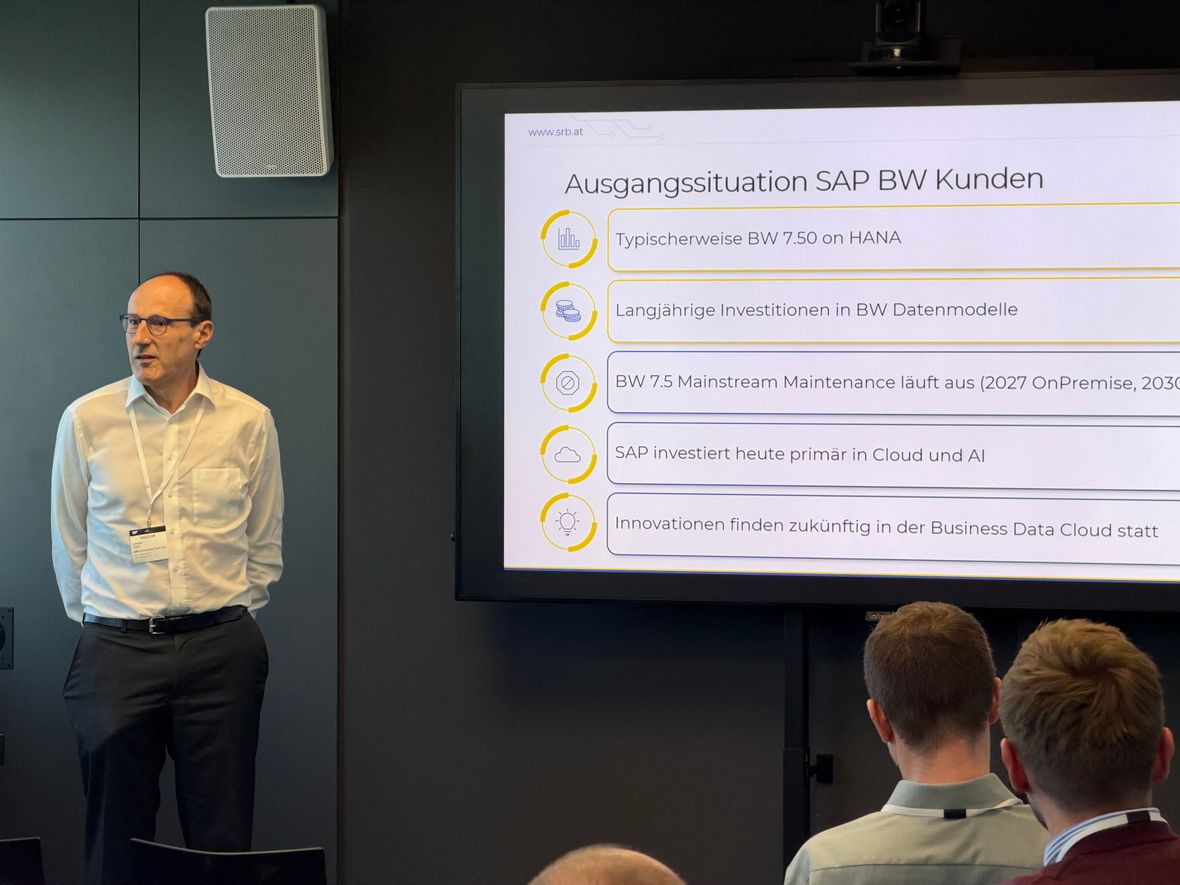
'Lift' describes the largely unchanged migration of existing BW systems to the Private Cloud. This approach protects existing investments and minimises risks, but does not represent a true modernisation.
'Shift', on the other hand, takes a step further: Existing BW data is provided as Data Products and can thus be used in modern cloud scenarios, for example, alongside Datasphere, Databricks, or AI applications.
'Innovate' finally opens access to new possibilities such as SAP Managed Data Products, Intelligent Applications, Databricks, AI and analytics scenarios, as well as modern planning applications.
The central insight: There is no universally correct path. The appropriate strategy depends on factors such as system landscape, degree of modernisation, cloud strategy, and the company's specific requirements.
And because a BI Brunch must also live up to its name, culinary delights and conversations were not neglected alongside Business Data Cloud and AI. The buffet and the anniversary cake attracted at least as many interested visitors as the presentations.
SAP Analytics Cloud: On the Way to the AI Workplace
After the refreshment, Marko Čenčič from SAP showcased the latest AI features in SAP Analytics Cloud. It became clear that SAC is increasingly moving beyond traditional dashboards.
The focus was on new AI Agents that are directly integrated into the analytics and planning processes. Particularly exciting was the Data & Analytics Insights Agent, which can automatically generate reports and analyses from data models and business requirements. Users describe their goals in natural language, and the application generates suitable stories and evaluations from that.
In addition, new planning agents were introduced to assist with simulations, forecasts, and planning adjustments. The vision: to control complex planning scenarios through natural language instead of manually developing technical rules or data actions.
SAP Business Data Cloud Live
At the end of the day, participants received a practical insight into the SAP Business Data Cloud. The focus was on typical questions that many companies are currently facing: What is actually a formation? What do I need data products for? When is an asset sufficient? And how can Intelligent Content be used effectively?
An important point was the realisation that a formation creates the technical foundation, but does not automatically take over customer-specific extensions, governance concepts, or migration. It is rather a structured starting point with predefined content and best practices.
The distinction between assets and data products was also discussed vigorously. While assets represent individual data or analysis objects, data products serve the controlled, cross-organisational provision of data including governance, responsibilities, and lifecycle management.
Current possibilities and limitations in the use of data products in Datasphere also attracted particular interest. The question here is: When do data products actually provide added value, and when is a classic data model or an analytic model sufficient? The answer, as so often, depends on the goal: If it is about the controlled provision and use of data across system and organisational boundaries, data products demonstrate their strengths. For many analysis and reporting scenarios, however, an analytic model is already sufficient.
Everything is coming together
The 10th BI Brunch has shown that data platforms, analytics, and artificial intelligence are increasingly developing into a common discipline. Business Data Cloud, SAP Analytics Cloud, and Business AI create new opportunities to further exploit existing investments while simultaneously implementing modern analysis, planning, and AI scenarios. At the same time, it became clear that technology alone is not enough: data quality, governance, specialist concepts, and clear use cases remain the decisive success factors.
And because a jubilee edition not only provides food for thought but also an occasion for celebration, both were part of the 10th BI Brunch: the look at the next steps in data, planning, and AI as well as the joy over this round number. Between professional discussions and cake, there was enough space for what has characterised our BI Brunch since Episode 1: asking questions, sharing experiences, and engaging in conversation.
A heartfelt thank you to everyone who helped shape and celebrate this jubilee edition with us.