
SRB goes SAP S/4HANA, Part 1: The IT Service Provider Takes Charge

We live and love SAP. What we do for our clients, we have also executed ourselves: the move to SAP S/4HANA. It was a long and enjoyable journey – and we want to share it with you. Today Episode 1, Discover & Prepare.
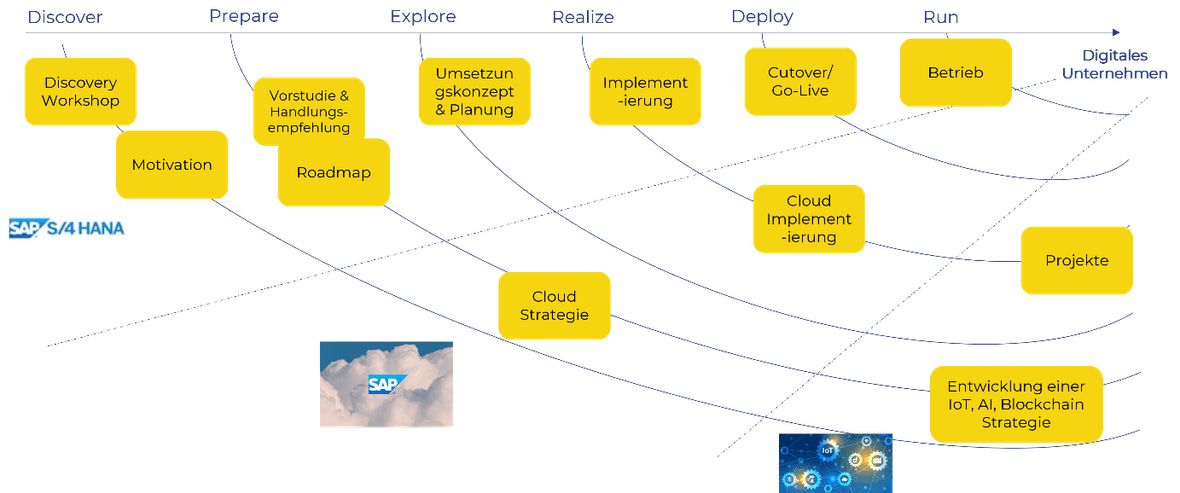
Recently, some of our colleagues received a new SAP certification: 10Steps2S4. We wanted to use this as a starting point to tell our own SAP S/4HANA journey. In December 2022, we arrived in the world of SAP S/4HANA. We, as SRB, did what we recommend to our clients and switched to the new platform of the Walldorf software house.
Our journey began in November 2021, as many of our projects do, with five small words: “Christian, do you have a moment?” These words came from one of our managing directors, Lorenz Juen. He had an idea, and in the conversation, it quickly became clear that it was now also time for us to transition from SAP ECC 6.0 to SAP S/4HANA.
We had gathered enough experience with it and the platform itself since 2015 through many client projects, including various clients like Polytec, a tobacco wholesaler, and a company in the oil and refinery sector.
Discover – Analysis on a Small Scale
The first task was – as it usually is for our clients – clear: conduct an analysis. For this, I coordinated with my colleague Herwig Stecher regarding new hardware and the technical transition.
At this point, we would have conducted or offered a 'Discovery Workshop for SAP S/4HANA' with the client. However, this was omitted for us, as the scope of our IT was manageable compared to some large corporations, and the goals of the transition were already largely established.
Essentially, the outcome of such a workshop is the definition of the strategic goals of a transition and the development of a roadmap. In the context of a current state analysis, business processes, systems, and data are analysed to understand the current state and identify where the challenges and improvement potentials of a transition lie.
Usually, a listing of the objects of consideration in the form of a mind map helps to determine what the scope of the project will be. How it was for us is shown in the following graphic:
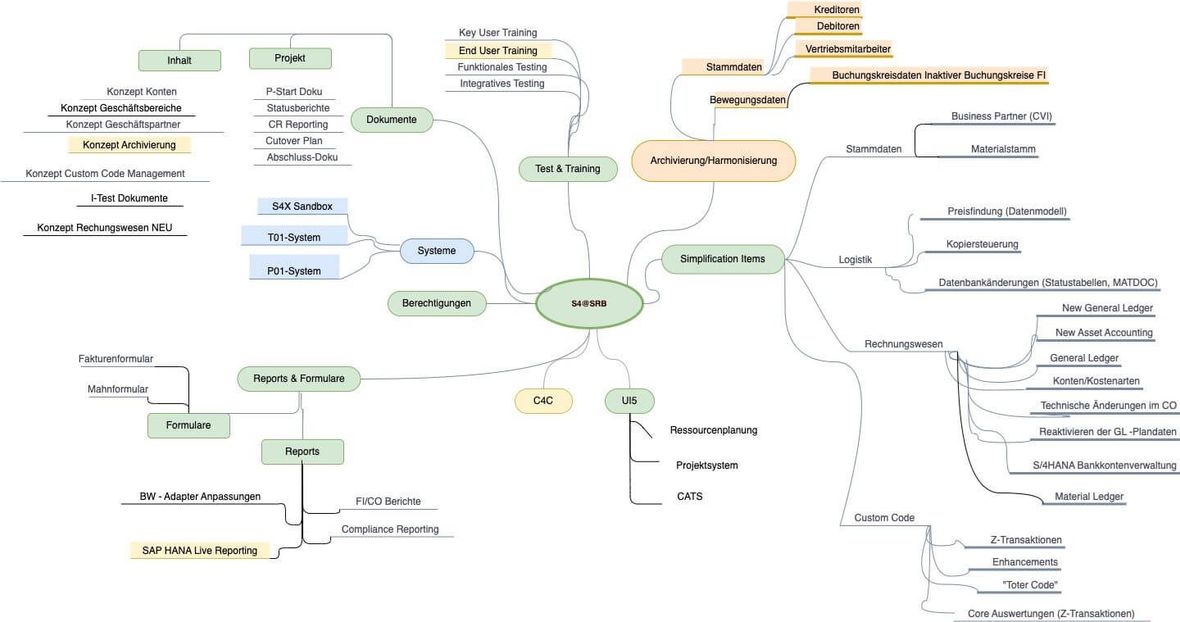
Figure: Objects of Consideration SAP S/4HANA @ SRB
Prepare: We are almost there
However, the next step on our journey was significantly more complex and extensive. A first readiness check was conducted by Martin Kasper, Customer Innovation Management – essential for an SAP S/4HANA project. Three phases need to be traversed:
1) Preparation
This involves implementing notes. Notes represent the SAP standard tool for program corrections and describe how known errors in SAP systems can be resolved. The transaction SNOTE, the note browser, is very helpful in this regard. The most important notes for us were
- 2502552 - S4TC - SAP S/4HANA Conversion and Upgrade of New Simplification Item Checks
- 2913617 - SAP Readiness Check for SAP S/4HANA
Depending on the patch level of the system, this can be more or less complex. “You even have to expand notes to implement newer ones,” was heard from Martin Kasper.
2) Execution
After preparation, it gets serious: Using the report RC_COLLECT_ANALYSIS_DATA, it can be selected which checks should be performed.
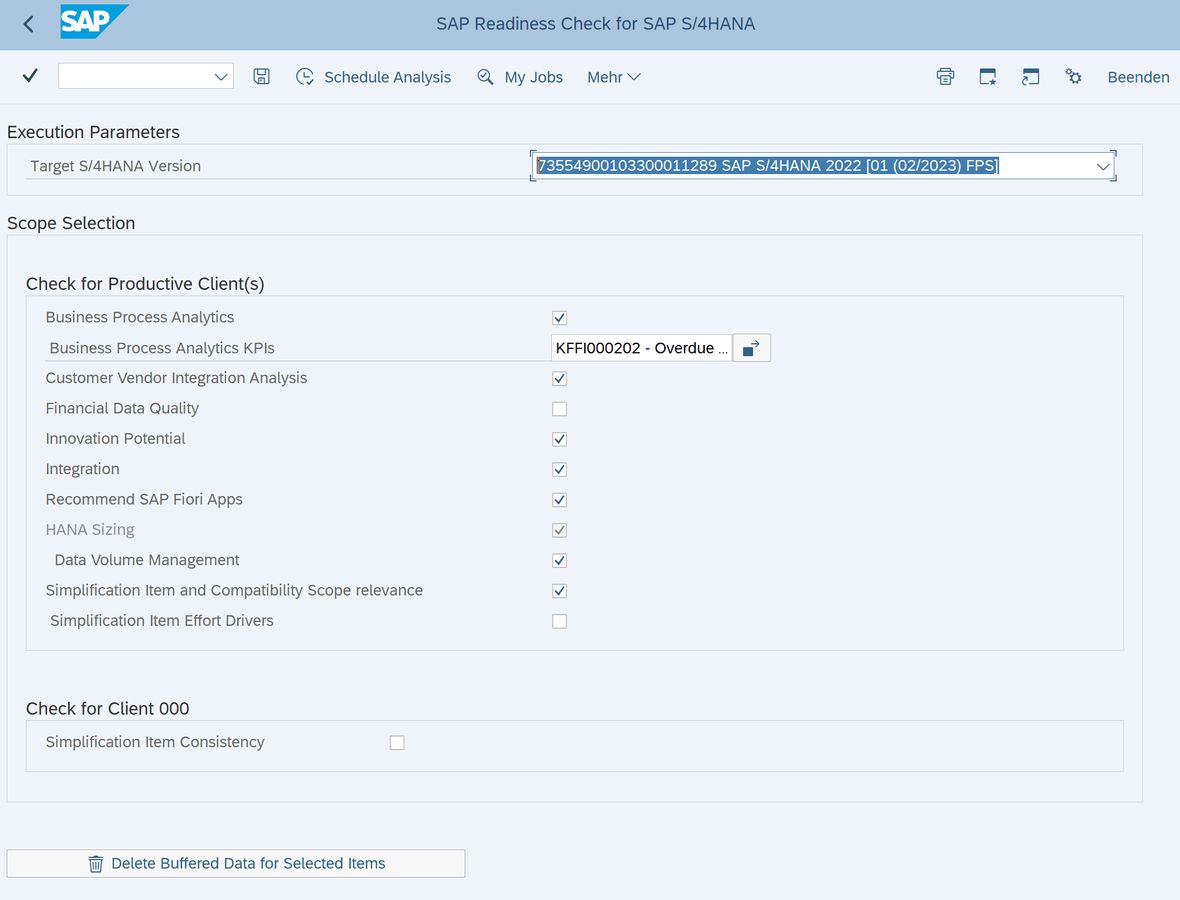
Depending on the scope and size of the system, the runtime may vary. Therefore, this should be planned during a booking-free period. The result of the readiness check is downloaded into a ZIP file and uploaded to the SAP Support Launchpad.
3) Evaluation
The core question that arises during evaluation is: What does the SAP Readiness Check for SAP S/4HANA migrations entail?
The SAP S/4HANA Readiness Check is a tool developed by SAP to verify whether your current ERP system is ready for migration to SAP S/4HANA. This check analyses various aspects such as business data, processes, and programmes in your system to identify necessary adjustments.
The SAP S/4HANA Readiness Check includes several fundamental checks, including:
- Simplification Items:A list of objects that have either been changed or are no longer present in SAP S/4HANA.
- Sizing: The calculation of the required database storage for the SAP S/4HANA system.
- Integration: The verification of active IDoc interfaces and extractors.
- Custom Code Check: The review of custom developments.
- Business Process Discovery: An analysis of the processes present in your system. Using provided KPIs, potentials or weaknesses in your system are uncovered.
- Add-Ons:The review of third-party extensions.
Additionally, there is the option to include further checks such as an analysis of financial data or business partners in the SAP S/4HANA Readiness Check.
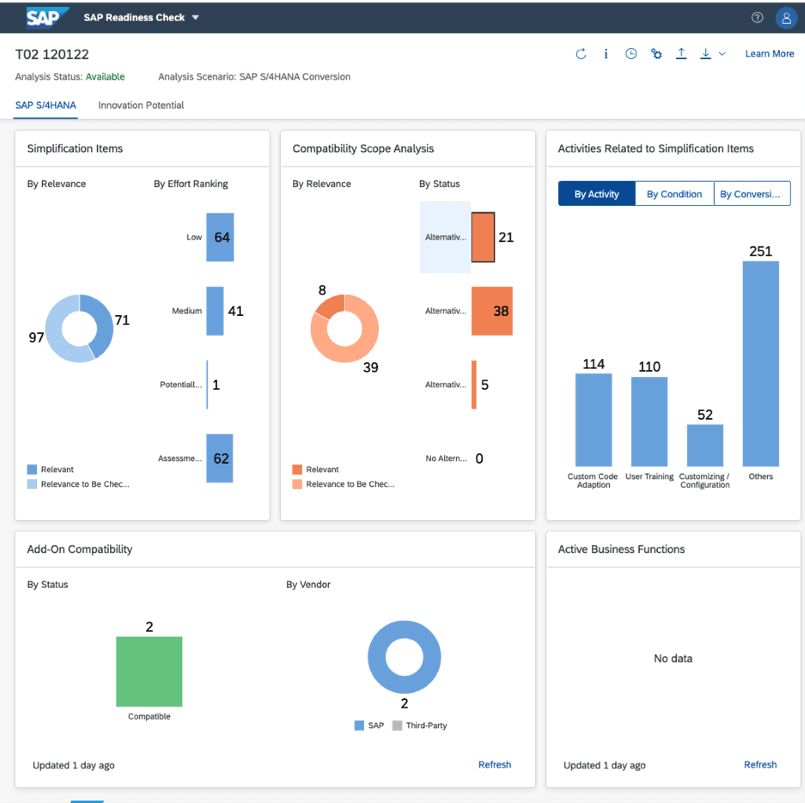
During the readiness check, the relevant objects that needed attention during the transition were identified. For us, this included the transition to Business Partner (CVI), new asset accounting, and adjustments to our custom code.
An important outcome from the readiness check was also the statement of whether there are so-called 'showstoppers' in the existing system. These could be add-ons that cannot be uninstalled. Further information on the preparatory activities for the SUM could be found in the pre-check report '/SDF/RC_START_CHECK'.
And even more preparation
Anyone who thinks that was it is mistaken. The next step was to find the right people for the project and assemble a competent core team. In a house full of consultants, we had the luxury of choice and the opportunity to form a team with the 'crème de la crème' of the SRB consulting landscape. In other words, a team with the employees who know the system and processes best.
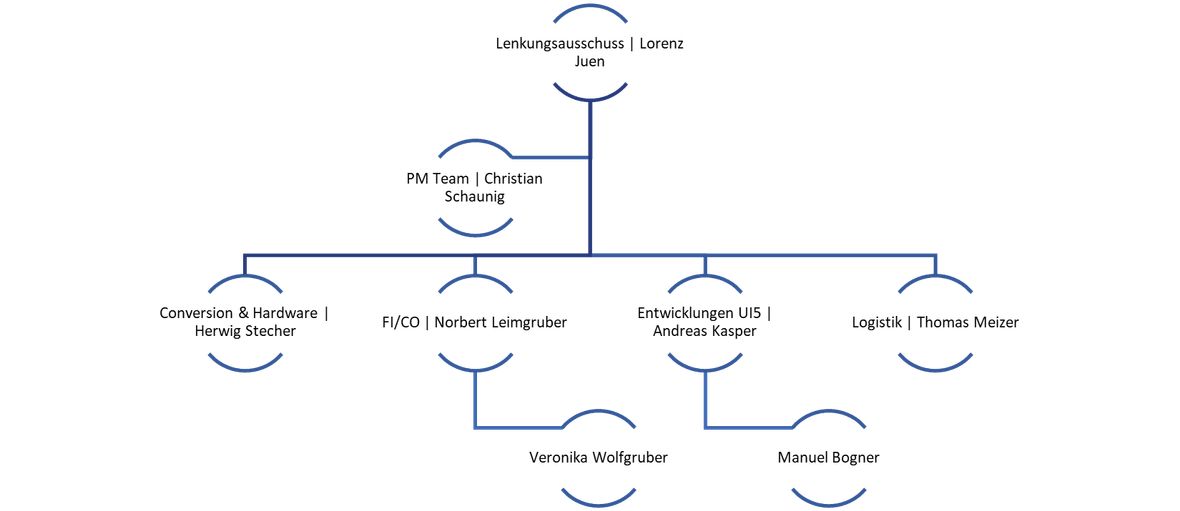
To drop a few names: Among these consulting colleagues were Thomas Meizer, Michael Breiner, Lorenz Juen, Norbert Leimgruber, Herwig Stecher, Andreas Kasper, and Ursula Zanitzer to be found. They were supported by Veronika Wolfgruber and Manuel Bogner.
To leverage the expertise of all these SAP professionals, we decided to conduct individual interviews based on varying availability and time, divided into the following areas: Hardware & SAP Basis, Processes, Custom Code, Reporting, and Interfaces. In this process, the scope of the current system and the areas where something needed to be done during the transition were developed and established.
Furthermore, due to the topics to be addressed, a project team was formed that changed depending on the phase or was adjusted based on specific expertise:
For completeness, it should not be forgotten that part of the prepare phase is also a pre-study that allows a closer look at the transformation path, scope, and project plan.
Brownfield, Greenfield, or Hybrid? The Dilemma for Us Too
Like all other clients, we faced the dilemma and decision of which path to SAP S/4HANA would be the right one for us. Since Greenfield corresponds to a new implementation, resources such as costs, time, and scope would be high for a company like ours.
The same applies to Hybrid. The hybrid transition occurs on a shell system and is particularly interesting for large companies and global system landscapes with booking circles and plants in the two to three-digit range. This is also the most expensive option, as specialised services from SAP or SAP partners are required.
So, Brownfield remained. Brownfield is the fastest, most economical, and simplest way to transition to SAP S/4HANA. Special consideration must be given to the preparatory work involving simplification, archiving, and custom code cleaning. Due to the manageable master data on our side, no harmonisation or cleaning was necessary or planned. What sounds like the simplest option should not be underestimated. For Brownfield also has disadvantages. Selective transition or system split or consolidation is not possible, and old data that is no longer needed will remain in the new system.
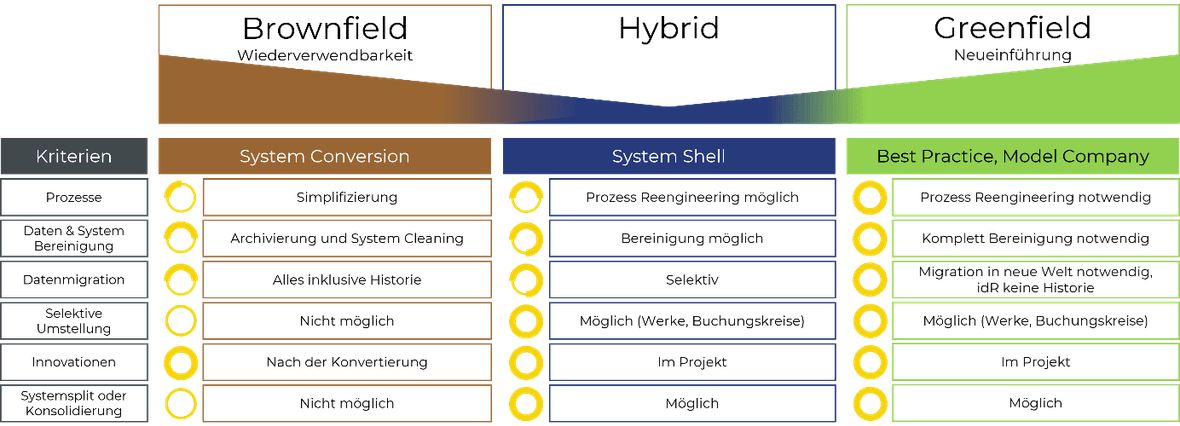
Even though it seemed obvious at first glance, and despite our many years of experience, the decision for the right transformation path was more difficult than expected. On one side was the innovation potential offered by SAP S/4HANA – especially regarding the mapping of processes, user interfaces, and reporting options, while on the other side was a swift and cost-effective implementation of the project, with the option to utilise the complete SAP S/4HANA innovation potential at a later date.
Which path should it be? Depending on the department and interests, opinions were contrary. Here, it was important for later success to hold discussion rounds and listen to all these opinions. Ultimately, a decision had to be made that would be supported by everyone. The compromise solution was: “Let’s transition now and later evaluate SAC, the C4C connection, and new process design,” was the consensus. So, Brownfield it would be.
Once that was clarified and decided, we of course also took a close look at the corresponding transformation path regarding the Brownfield approach:
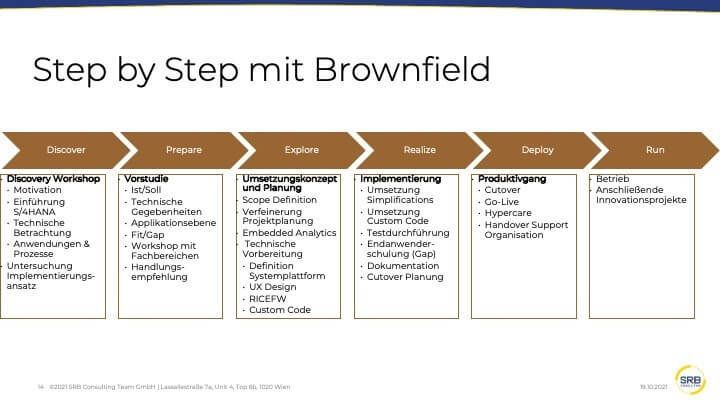
In November 2021, we were at the end of the prepare phase, and our first project plan for the migration was established. Unsurprisingly, this would change over time. It is noteworthy that we further divided the realize phase – firstly into a phase for implementing the preliminary projects (EHP8 upgrade & CVI) and secondly into the technical SAP S/4HANA implementation. As experience from other projects has shown, planning is very important. Considerations and preparations are reflected in the following high-level overview of the project. Here, the essential phases and key activities are visible.
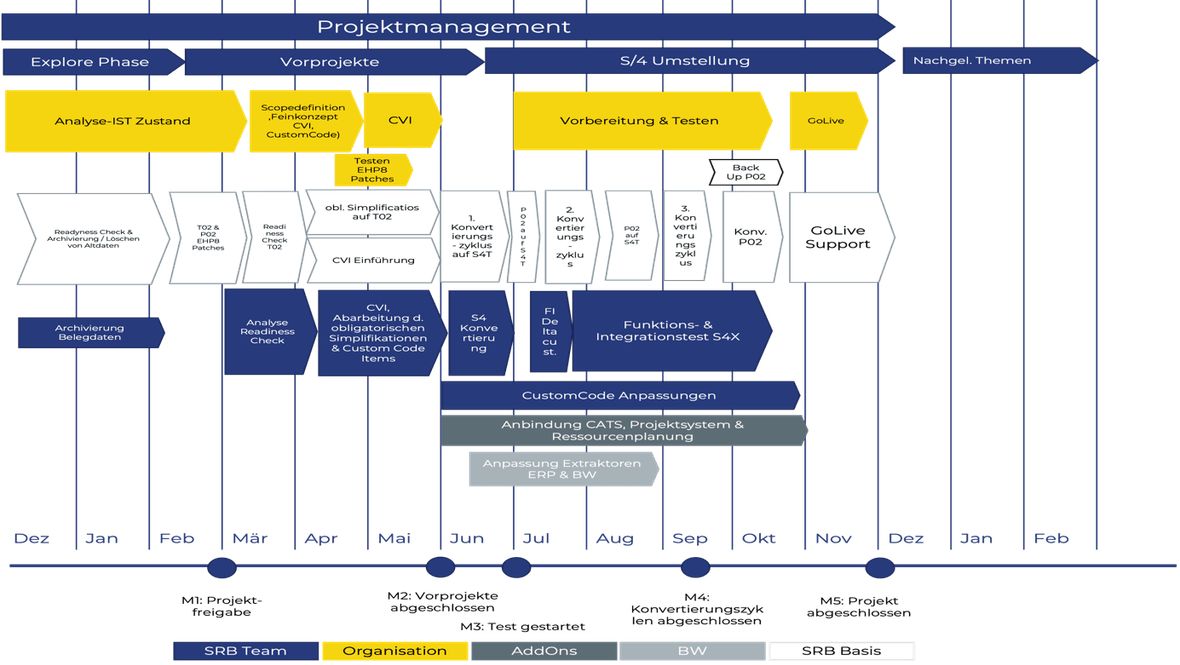
A Piece of the Journey
The glorious team, the transformation path, a timeline, and the 'rough' goals were thus established. A small piece of work was done. To ensure everything ran smoothly and timelines were met, not only was a project plan created, but regular meetings were also introduced. Everyone should always be clear about what needed to be done.
Planning also had to take into account other factors such as supply chain issues with hardware due to COVID. Thus, the planned delivery of hardware for us did not occur before April – this buffer had to be considered and incorporated. To further minimise risk, a phase for preliminary projects was also planned, during which an upgrade to EHP8 and the CVI transition took place.
In summary, the focus in these phases from the idea to the first planning was to determine what the scope of the project would be and how we could implement it with which resources. In this process, analysing the processes was important to determine the scope. The strategy for implementation was, despite numerous discussions due to the 'size of the system', relatively clear in the end.
A significant point is also to secure the necessary resources and to start planning the project based on the insights of many, which would then be refined in the subsequent phases. The foundation was thus laid before the next phases, Explore & Realize, would truly begin. But that will be for next time.
Strategies & Methods
If you are also facing migration to SAP S/4HANA or have questions about our path to the new platform, simply contact me. Additionally, I have compiled interesting supplementary information for you regarding the first two phases of the transformation journey:Information Sheet 1: Strategies & Methods


