
SAP Datasphere: Here’s how to get into the Data Warehouse Cloud!


In recent months, Irene Preiner had the pleasure of accompanying and advising an internationally active client in testing and setting up SAP Datasphere. Read here how it feels, how the DW Cloud works, and what it can do.
In recent months, I had the pleasure of accompanying and advising an internationally active client in testing and setting up SAP Datasphere. Read here how it feels, how the Data Warehouse Cloud works, and what it can do.
What is it about?
My client is an internationally active producer of baby products such as pacifiers, baby bottles, and nursing products. Production takes place in several countries, as does marketing. The existing ERP system is being phased out and will now be replaced by SAP S/4HANA private Cloud.
For reporting – and this is where I come in – initially only SAP Analytics Cloud (SAC) was considered. However, the joint analysis last year showed that several SQL databases are running to cover reporting. Since data from subsidiaries without SAP should also be included in reporting and a non-SAP reporting tool in one country should continue to operate, the recommendation was clear: SAP Datasphere makes a lot of sense here.
What exactly is SAP Datasphere?
SAP Datasphere is a comprehensive data service, fully in the cloud. In other words: a data warehouse with extensive functions to connect various data sources, link, prepare, enrich, and make data available for reporting. Reporting can take place in SAC, but it is not mandatory. Unlike on-premises solutions (BW, BW/4HANA), Datasphere is designed to be much more open.
Of course, there are also permissions, spaces as 'modelling areas' for departments, and much more. It can be clearly stated: SAP Datasphere is not only for administrators but also for key users, as it is more intuitive and simpler than BW or BW/4HANA. The basis is the BTP (Business Technology Platform). Here is a nice overview image from SAP:
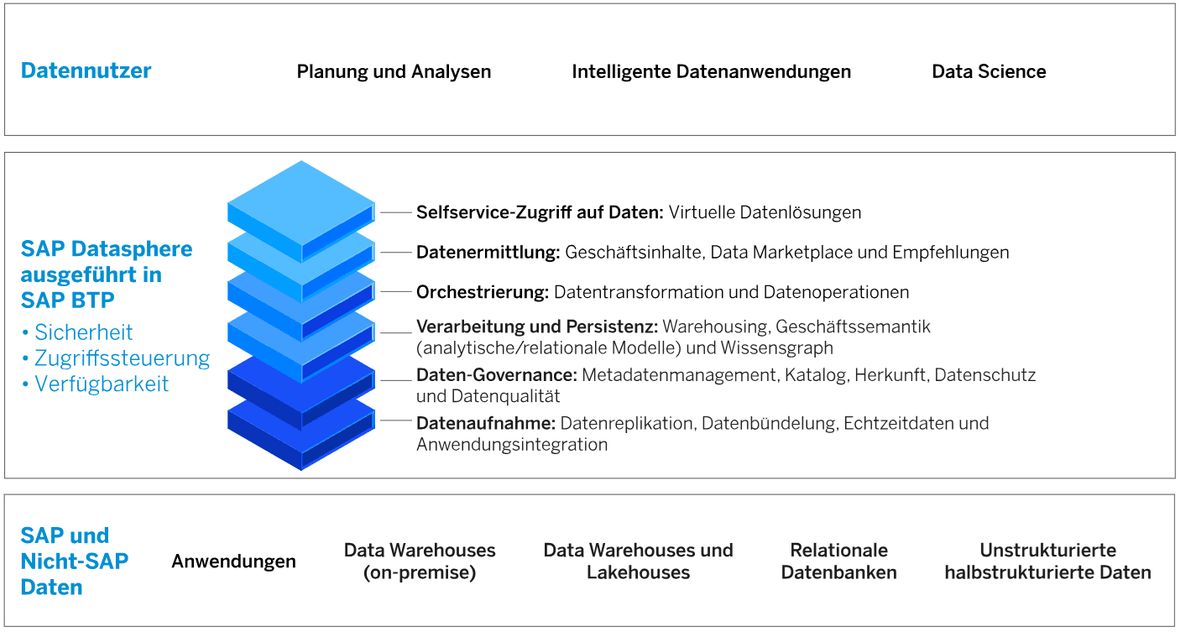
Source:sap.com
Why not SAP BW?
You may be wondering why SAP Business Warehouse (BW) was not chosen for the previously mentioned project? The question is absolutely valid. And of course, this was discussed. Since the client had already decided to move to the cloud with SAP S/4HANA and for SAC, SAP Datasphere was the obvious addition.
The Datasphere is therefore positioned 'between' SAP S/4HANA and SAC to collect all necessary data (including non-SAP and Excel), clean, model, and then prepare it for reporting in SAC. A major advantage for the client: The country with the non-SAP reporting tool can also consume data from Datasphere – and this with very little initial effort to establish the connection.
How does an implementation proceed?
But how does one proceed to replace a reporting landscape that has grown over many years? The answer is like with many projects: step by step. The beginning was made with an inventory, followed by prioritisation. This had already been done last year.
We started the project at SRB with a strong internal team of 4 people, a list of necessary reports, and clear priorities: reports needed immediately at Go-Live, those that can wait 8 weeks, and those that should be considered but implemented in a third wave, 4 months later.
And one more thing was already clear in the preparation phase last year: The main work will be done internally, not by external consultants. Therefore, in the first joint workshop, the request to me was:
‘Ms Preiner, please teach us everything from the start; we want to do it ourselves!’
‘Is that possible?’ you may ask. Yes, it is. However, it requires a team that knows exactly how the business operates and is very familiar with the existing reporting landscape. The fact that team members can also programme SQL on the side was an additional advantage.
And one more thing plays a role when it comes to the success of such a project: SAP Datasphere is 'closer' to an SQL Data Warehouse than SAP BW. The 'aha' effect in the workshops was significant: Many processes and objects were immediately recognised, compared with the old tool, and parallels were drawn. This made it much easier. Nevertheless, we had several workshops to set up the system, establish guidelines for object names, layers, permissions, and so on.
And then the time came: The last workshop took place – and the client's internal colleagues began working without me.
What have we learned and achieved?
As with any project, there were of course questions and minor hurdles here as well. One of the biggest challenges is certainly bringing the data via CDS into SAP Datasphere. Do not forget: SAP S/4HANA is also new! My suspicion is that finding relevant CDS views and any adjustments takes more time than the activities in SAP Datasphere itself.
Moreover, SAP Datasphere opens up more possibilities than the previous SQL databases. In SAP Datasphere, for example, data can be loaded using a delta mechanism. The old solution only offered 'full'. The modelling options are also significantly more extensive.
My suggestion was to create a 'cookbook' that contains the procedure as well as tips and tricks. It was important that this should not be created and filled by me, but by the internal colleagues – while working with SAP Datasphere. After a few weeks, I received very positive feedback: The cookbook had been filled with life and was considered extremely helpful by everyone.
And I do not want to overlook one more challenge: Carrying out an introduction project of this scope alongside daily business is really time-consuming. The internal reporting team will therefore be strengthened in the near future. However, external support is not planned further. 😊 The Go-Live for SAP S/4HANA, SAP Datasphere, and SAC is scheduled for 1 January 2024. So there is still some time.
Do you want to know more?
Rest assured: I will report more on this project in the future, how it progresses and where the journey is headed. If you want to know more and hear firsthand what is happening in the client's SAP Datasphere, then just come to the7th BI Brunch on 28 September 2023.There, the client will personally share their perspective. More information and the possibility to register can be found


