
SAP BW/4HANA: Remote or Shell Conversion?


Many paths lead to SAP BW/4HANA. More precisely, there are four. But which is the best conversion when switching from BW to BW/4HANA?
Our starting situation is one that is likely familiar in many local companies: Over the years, our client's BW landscape, based on BW 7.5 and a SQL database (Non HDB), has grown and established itself as the central data hub in the company. Therefore, appropriate attention should be paid to transitioning this platform into a new era and migrating to BW/4HANA.
The easiest way is not always the best
In principle, as already mentioned, there are four variants for switching from BW to BW/4HANA: The In-place Conversion, the Remote Conversion, the Shell Conversion, and the Green-field method.
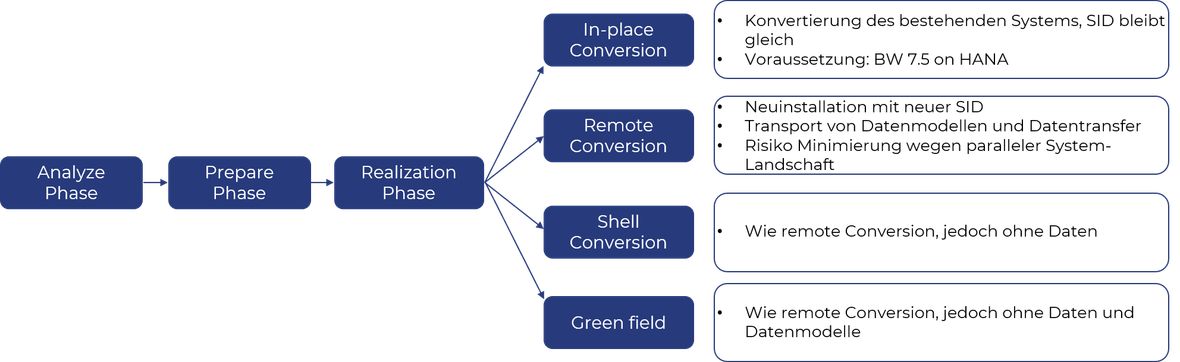
At first glance, the In-Place Conversion seems to be the easiest way. The obvious reason: For the end user, the least changes occur: keyword same SID. However, an in-place migration becomes complex when many 3.x data flows are still in use. Additionally, there is a corresponding need for re-design or the elimination of applications.
All of this weighs heavily when considering that a company does not want to take the detour via BW on HANA but rather wants to quickly see the benefits of BW/4HANA and build up corresponding know-how. Therefore, it makes sense to also look at other variants – especially Remote Conversion and Shell Conversion.
The best of different worlds
In our example, the Remote Conversion variant should be analysed in the POC. This led to the following work packages:
- Installation of BW/4HANA 2.07
- Installation of DIMS on BW and implementation of many notes (Z_SAP_BW_NOTE_ANALYZER; programme for analysing which SAP messages need to be applied)
- System architecture naming convention new
- Execution of the conversion
- BADI variable exit
- Creation of Analysis Office workbooks (old system BEX Analyzer)
- Roles/authorisations
- End customer presentation
So far, the plan. It quickly became clear that the work on Z_SAP_BW_NOTE_ANALYZER could become quite complex if the original BW system has a low patch level. In our example, the BW system was patched only half a year ago. Nevertheless, time had to be invested here as well.
The first tests were then carried out using Shell Conversion – and to our surprise, all conversion transports were imported error-free the first time. Encouraged by this, we gradually increased our efforts and ventured into InfoObjects, InfoCubes, MultiProviders, queries, and transformations. Successfully.
Subsequently, we attempted to migrate a provider using Remote Conversion (like Shell, but with data). However, a Remote Conversion is considerably more complex than a Shell Conversion, especially regarding the entire system landscape (Dev – Qual – Production).
What has always bothered us during the conversion is that a change of technical names is not possible. However, since we found a way to change these names during the Shell Conversion, it has also become our preferred solution. The data is then either loaded again from the ERP via an ODP source system or loaded from the original system via a direct ODP-BW connection.
The old CMOD variable exit was rebuilt as a BADI class on BW/4HANA. SAP recommends carrying out the variable restructuring directly on the existing BW system, but we did not want to conduct retests on the existing BW system.
Due to the flexibility regarding the new technical names, the Shell Conversion can also sensibly support a Green-field installation in specific cases.
Lessons Learned – reaching the goal via detours
In summary, it can be said that while our client did not achieve the actual project goal of Remote Conversion, they are still very satisfied with the result of the Shell Conversion. The reasons lie mainly in the fact that a Shell Conversion is significantly more flexible than a Remote Conversion, especially because the technical names can also be adjusted.
The technical migration worked flawlessly, and the missing data can easily be reloaded via ODP-BW connection from the old BW system or from the ERP. Additional benefit: A DIMS add-on is not necessary for a Shell Conversion, and fewer notes need to be implemented.
All in all, it can be said: Every type of conversion has its advantages and disadvantages. At the end of the day, it depends on the individual composition of the BW and the desired outcomes which method or even which mix of methods proves to be the most efficient and simplest.#_msocom_2Even if one has already found a favourite, the analysis phase is unavoidable to find the right conversion.
SRB – Your partner for a successful conversion to BW/4HANA
Do you also want to know what the best path to SAP BW/4HANA is for you? Can we support you on your personal journey to a successful conversion? Simply contact me atl.juen@srb.at.


