
Recap TechEd 2020: SAP Data Warehouse Cloud


I would like to provide a brief overview of the SAP Data Warehouse Cloud, and those who wish to learn more will find further exciting links at the end of my blog.
TechEd 2020 was held online and free for the first time this year. THE technology fair of SAP is very popular among us nerds as well as many other IT enthusiasts. The highlights: Detailed presentations on topics from all SAP areas, including insightful demos. Product managers and developers provided insights into future developments and roadmaps.
I must point out that a live event has more 'flair' than an online event. The personal component is simply missing: wandering through the halls with other participants in search of rooms and presentations – that’s how you start chatting. And let’s not forget meeting the developers in person and experiencing the occasional mishap during a live demo. Not to mention the evening events...
No disadvantage without advantage:
For those who missed TechEd 2020 or could not attend parallel presentations, they can still catch up now!
But back to the content:
This time, I focused on the SAP Data Warehouse Cloud. And if you are wondering (as I am) what it is good for, please read on.
I would like to give a brief overview, and those who wish to learn more will find further exciting links at the end of my blog.
First, to two central questions:
- How does SAP position the SAP Data Warehouse Cloud against on-premises solutions?
- Is our well-known BW or BW/4HANA already history?
Here, I can immediately give the all-clear: a very clear no from SAP! On the contrary, maintenance of BW/4HANA will definitely continue until 2040.
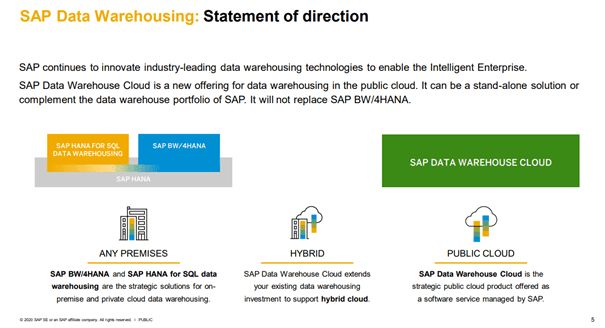
This slide appears in every TechEd BW presentation (here from the ANA108 presentation) and positions BW/4HANA and SAP HANA for SQL DWH as an on-premises solution.
source: SAP
So, that clarifies why we need an SAP Data Warehouse Cloud.
The answer is simple and obvious: the existing BW/4HANA solution is largely IT-driven. Changes in the data model must be made by administrators, and data loading as well. Here, the 'freedom' of the business clearly conflicts with 'governance' by IT/BI. With the Data Warehouse Cloud, SAP aims to resolve this conflict: business users receive a solution that can be operated without IT, moving towards 'business-oriented' instead of 'IT-oriented'.
What does this mean in detail and in practice?
As with the SAP Analytics Cloud, SAP offers an intuitive, state-of-the-art interface where all tasks can be performed with drag & drop. The central idea is that a business user can easily access data, adapt it to their needs, link it with other sources, and then use the integratedSAP Analytics Cloudto create appealing reports. It is directly selected via theStory Builderin the interface.
Admittedly, the demos are very impressive: starting from aSpace, the user determines who may see the data and which sources are included. SAP has done a great job with the data sources. The goal is to integrate all types of structured and unstructured data sources with just a few clicks.
TheData Modelingtakes place in the brand-new Data Builder. Again, it is very intuitive and, if necessary, with scripting (standard Python 3 scripting language), where the graphical options appear to be very extensive.
SAP also offers another solution: there is aBusiness Catalogas a basis for business users to find, create, modify, and define objects. This does not exist in this form in BW/4HANA.
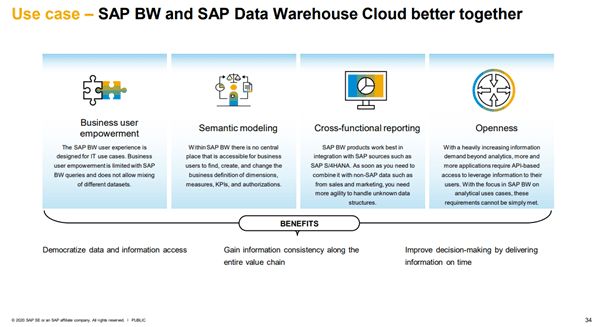
Of course, 'Business Content' is also delivered again, even in BW/4HANA, one of SAP's strengths.I would like to share one more slide. This shows, in my view, the limitations of BW/4HANA and how SAP aims to compensate for these shortcomings with the SAP DWC (also from ANA108).source: SAP
I have to smile at the buzzwords 'democratise data and information access'. However, the arguments for more 'business user power' cannot be refuted. The SAP DWC can make a good contribution.
Even though this year's TechEd Online Edition was organised with the usual SAP orderliness, I hope for a live event again next year.
I will definitely keep an eye on the SAP DWC and will continue to report on it. :-)
Tips: Presentations for reading and listening
Road Map SAP Data Warehouse Cloud [ANA827]
Modelling Hybrid Scenarios with SAP DW Cloud and BW/4HANA [ANA205]
SAP Data Warehouse Cloud: Overview [ANA108]


