
Joule in SAC: AI and context enter analyses

Joule is integrated into the SAC, marking a new phase of data-driven work. Innovations show its development: away from technology-driven analysis processes, towards a more AI-supported, context-aware approach.
Joule is integrated into the SAP Analytics Cloud (SAC) – thus beginning a completely new phase of data-driven work. The innovations presented at the SAP TechEd 2025 clearly demonstrate the platform's direction: away from purely technology-driven analysis processes, towards a more AI-supported, context-aware approach.
The SAP Analytics Cloud, originally designed for classic BI, planning, and forecasting scenarios, gains an additional technological layer with the beta version of Joule. The key point: natural language becomes the central interaction model, and analytical processes are no longer solely controlled through menus, technical objects, or manual modelling. Instead, Joule translates business requirements directly into analytical and structural actions. The focus increasingly shifts from technical setup to content-related questions.
For departments, BI managers, and executives, this means not only a functional expansion but also a structural change in how analyses, planning models, and reports are created – with direct impacts on time-to-insight, skill requirements, and the organisation of BI teams.
Joule as an integral part of the SAC interface
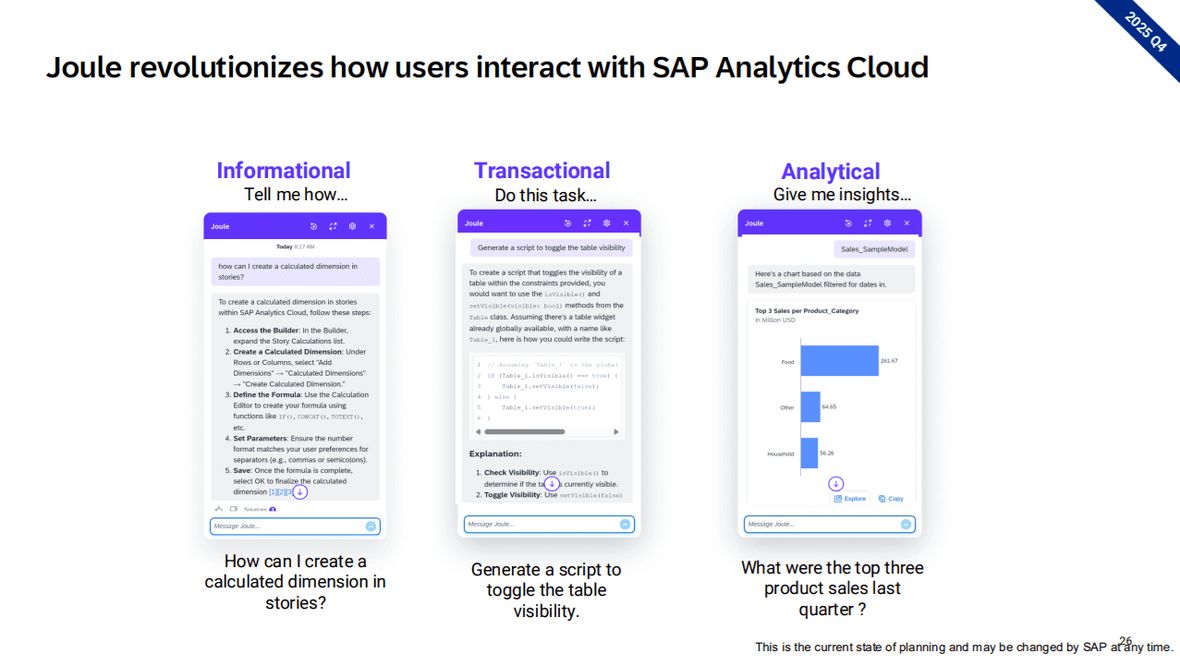
In the current beta version, Joule is not visible as a separate module but as a functionally embedded part of the interface. The AI automatically recognises the context in which users operate.
For instance, when working in a data model, Joule interprets the available dimensions, hierarchies, and metrics. In a story, the AI captures the existing widgets, their bindings, and the underlying data source, while planning functions consider versions, booking types, aggregation logics, and permission structures.
Source: SAP TechEd 2025
This contextual understanding allows commands in natural language to be translated into operations that would traditionally require highly technical interactions. Joule knows which transformations are logically possible in the current model, how they can be implemented syntactically correctly, and how they remain consistent with the existing data.
As a result, the user experience fundamentally changes: many of the previously necessary manual clicks and modelling steps are eliminated. The AI takes over tasks such as data preparation, structuring, analysis, and visual representation.
From an organisational perspective, this significantly relieves power users and IT-related roles. Business users can trigger complex operations without needing to know every technical detail, while governance, permissions, and model consistency remain secured by the existing SAC structures.
AI makes it possible: coding without coding skills
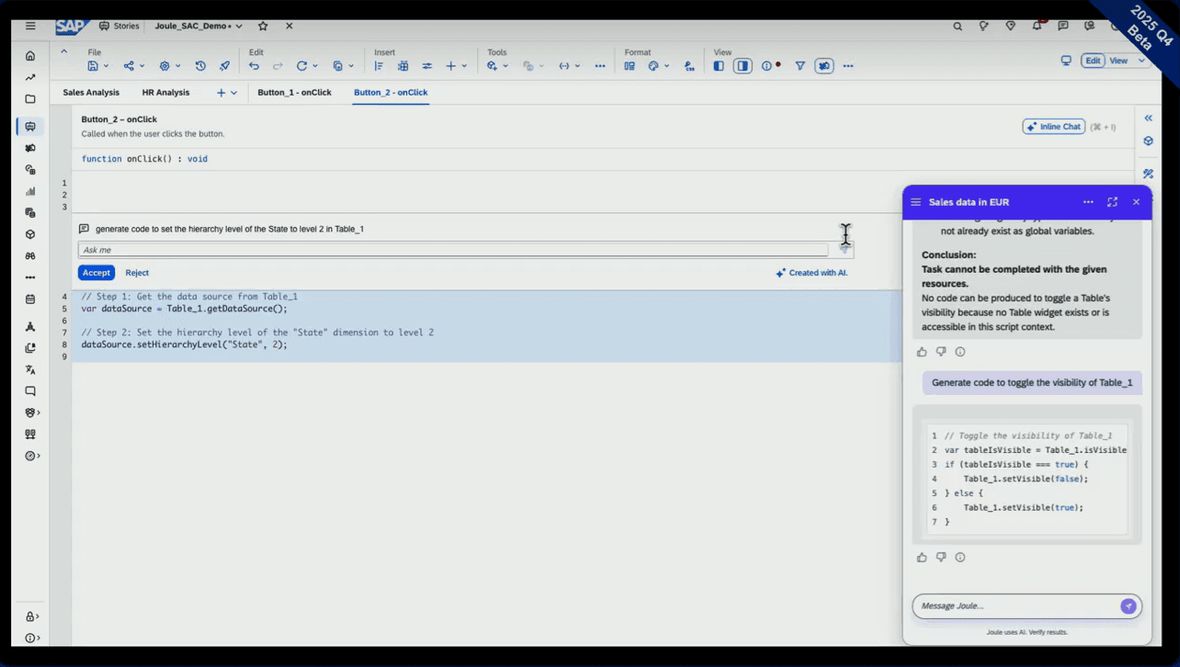
A particularly significant advancement lies in Joule's ability to autonomously create code in various SAC contexts. This code generation is based not on simple text blocks but on a detailed analysis of the model, the semantic relationships between objects, and the users' objectives.
For example, when a planning logic, a calculation on a fact table, or a data update is described, Joule generates complete script fragments that meet formal requirements for syntax, variable types, aggregation functions, and model boundaries. The AI draws on internal model metadata, technical descriptions, and internal best practices. It also considers whether an operation is permissible on a specific version, how consolidation is structured in a model, or what restrictions exist in the data model.
Source: SAP TechEd 2025
This type of automated code creation minimises typical sources of error such as incorrect aggregation methods, incomplete WHERE clauses, or syntactic inaccuracies. At the same time, it increases the speed at which technical solutions can be implemented.
This addresses not only classic developer roles but also advanced users, planning managers, and BI architects, who previously had to build deep technical expertise. The dependency on individual key persons is thus immensely reduced – as is the turnaround time of development and adaptation cycles.
It is important to note that Joule always operates within the existing model, permission, and governance structures of the SAP Analytics Cloud. The responsibility for business logic, approvals, and quality standards remains with the company or the respective decision-makers.
The Story Generation Agent as a new architecture for analytical content
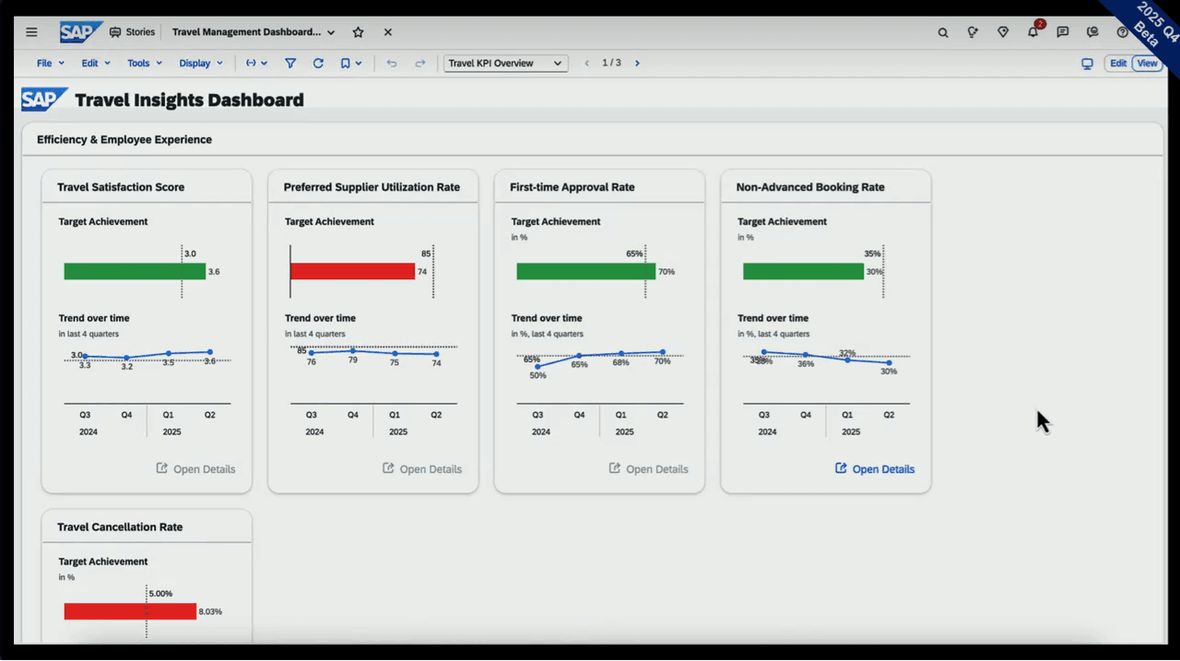
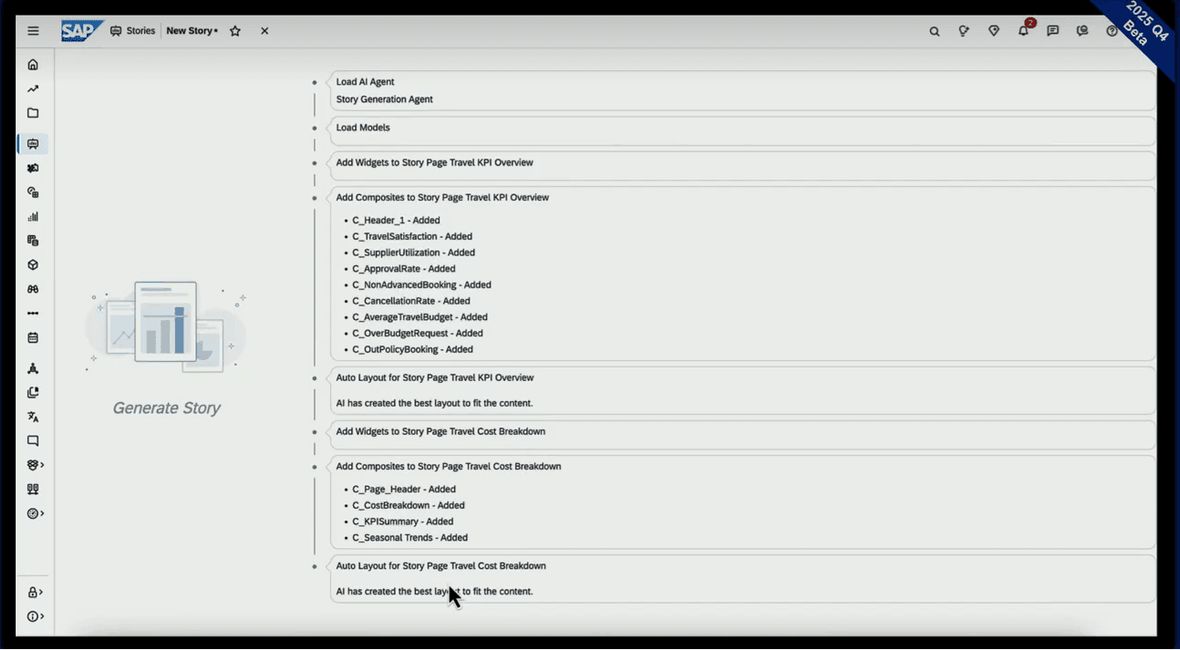
The Story Generation Agent also represents a significant leap in efficiency. It extends the concept of AI-supported development to the creation of entire reports. The innovation lies in the fact that the AI not only generates graphical elements but also creates complete stories based on a holistic understanding of data structure, business objectives, and typical visualisation behaviour.
Source: SAP TechEd 2025
The AI analyses business requirements, interprets the semantic meaning of metrics and dimensions, and generates a coherent analytical representation from this. It decides which visualisation forms are most meaningful for a given issue, how these are logically arranged, and which data bindings are necessary to ensure interactivity and flexibility.
Furthermore, Joule takes care of the design preparation of the story. Layout, style, colour design, and interaction logics are built consistently, and filtering mechanisms, parameter controls, and navigation paths are automatically inserted, making the story immediately usable for analysis or presentation purposes.
Strategically, the Story Generation Agent enables greater standardisation of analytical content. Reports follow more uniform patterns, interpretations become more comparable, and deviations are recognised more quickly. This opens up the possibility for BI leaders to centrally set analytical standards without having to manually develop each story. The agent thus covers the entire story lifecycle – from conceptual entry through generation to the first analysis.
Source: SAP TechEd 2025
The future is prepared
Overall, it is clear that the integration of Joule into the SAP Analytics Cloud marks a clear shift in analysis and planning work. AI becomes a central component of workflows, taking on tasks that previously required deep technical expertise. Natural language serves as the new interface, while Joule independently interprets model logics and relationships.
Through generative story creation, automated code generation, and context-sensitive understanding, the use of the SAP Analytics Cloud becomes significantly more efficient. Technical complexity recedes into the background, while the business benefit comes to the forefront.
In the long term, Joule shifts the focus from operational report creation to the strategic management of data, semantics, and decision logics. This creates a new interplay of technology, governance, and decision-making for departments, BI organisations, and executives alike.


